Category: Conscious Consumerism: Shopping & Reviews

  • Pet Obesity: How about a New Year’s Resolution for Your Dog?

    Pet Obesity: How about a New Year’s Resolution for Your Dog?

    the dogness


    Diagnosis: OVERWEIGHT.

    That’s what it says on Jimmy’s vet visit papers.

    Jimmy is 35 pounds, and the vet thinks he should be about a 30 pound dog. That means we’ve been handed the heavy responsibility of trimming 1/7th of his body weight.

    He’s not alone, you know. 54% of this country’s cats and dogs are overweight or obese, which more than anything else I see as an indicator of unhealthy practices in the home. With kids, you can blame marketing and school food, to some extent. But dogs and cats depend on their humans for food and exercise.

    There are even fat camps for dogs. Check this one out, in Morristown NJ:


    Pets are susceptible to all the weight-related issues humans are: diabetes, kidney issues, heart disease, joint pain, osteoporosis.

    And, with pets as with humans, the real issues are:

    • quantity of food eaten: treats, table scraps
    • quality of food eaten: human junk food, overly processed food, dog chow that is mostly carb rather than protein
    • exercise frequency and intensity: not getting out enough, not getting to run and play

    The thing is, we Eltons get plenty of exercise— outside the house. I go to the gym or to the basketball courts, the kids have practices and games and recess and gym class. Once at home, we’re pretty sedentary creatures, and Jimmy has always fit in perfectly. This dog, I kid you not, goes to bed (BED bed, like even if the rest of us are still up he goes to the bedroom) around 11pm, gets up briefly with Cassidy to eat whatever she leaves in her cereal bowl, then goes back to bed until about 1pm. He just doesn’t have an active nature. Walking him around the block can take 20 minutes because he is content to sniff and meander.

    He also tends to get the leftovers from meals and whatever Cass drops on the floor, which is a lot. Kid is a slob.

    We’ve recently made some moves to better dog food for him. More details on that over the next few days, but generally speaking, you should look for ingredient lists that have:

    • whole meat sources as its top ingredients, rather than corn or grain based sources.
    • no generic meats— should read beef, or chicken, or lamb, or whatever, not “meat meal”
    • no corn gluten meal, a filler commonly found in lower quality foods
    • human grade ingredients, for quality control
    • no artificial colors or preservatives
    • no sugars or sweeteners

    Note, feeding instructions are generally for the “most demanding” life stage, so we may be overfeeding by as much as 25%. And it’s not like most pet foods list calorie counts, anyway. (This website does show calorie counts for pet foods, check it out.)

    A quick internet search suggests that dogs will love green beans as a treat substitute. I cannot confirm or deny at this time, but Jimmy loved a few bites of pineapple as an after-dinner treat tonight.

    With pet food as with so many things, as a nation we’ve caved to the cult of cheap. Cheap pet food is full of non-nutritionally-sound corn fillers that are make for round little bellies. Add that to a chronic lack of exercise and we have a nation of fat cats and dogs.

    It’s not like cats and dogs can run out to the store and buy better food. Or hit the gym on their way to work. They depend on us for the quality of their lives. And the quantity: an obese dog is just not going to live as long as one that’s a healthy weight. Just the facts, ma’am.

    So, Jimmy is getting a better diet, getting kicked outside more often, and once the weather warms I’ll be taking him to the park for walks. Because frankly we’d like to keep him around for a few more years.

    If your New Year’s Resolution was to drop a few pounds, or live a healthier life, maybe a better way to achieve that (by taking the focus off YOU) is to be conscious of your pet’s health: switch to healthier staples, incorporate more real unprocessed food, exercise frequently with bursts of intensity, and play regularly.

    I’ll check in with Jimmy’s progress. You keep me up to date on yours.

    Got a pet that could stand to lose a few?

    Tell me about it. Please. I feel guilty.



  • Patagonia: Eco Fashion is Ethical Fashion

    Patagonia: Eco Fashion is Ethical Fashion

    patagonia

    Because the greenest product is the one that already exists.

    -from the Patagonia website

    Patagonia is a clothing company that’s taking sustainability seriously.

    I’ve been meaning to write about them ever since they ran an ad on Black Friday that read “Don’t buy this jacket,” with this copy:

    The environmental cost of everything we make is astonishing. Consider the R2 Jacket shown, one of our best sellers. To make it required 135 liters of water, enough to meet the daily needs (three glasses a day) of 45 people. Its journey from its origin as 60% recycled polyester to our Reno warehouse generated nearly 20 pounds of carbon dioxide, 24 times the weight of the finished product. This jacket left behind, on its way to Reno, two-thirds its weight in waste… There is much to be done and plenty for us all to do. Don’t buy what you don’t need. Think twice before you buy anything.

    We’re then invited to take the Common Threads Initiative pledge, which asks you to reduce, reuse, and repair. Only when you’ve exhausted the usefulness of your item, should you then recycle. And then Patagonia introduces a the fifth R, to reimagine a world where we take only what nature can replace.

    It all seems counter-intuitive and somewhat gimmicky, and at the time I thought the selling point was that their clothing was hardy and well-made from quality fabrics and therefore long-lasting; so by BUY LESS they really meant buy Patagonia and you won’t need to buy as often. Which, don’t get me wrong, is a very valid argument.

    But Patagonia totally seems to be putting their money where their mouth is.

    • You can have your clothing repaired and your footwear resoled through the company; they will pay for repairs that they’re responsible for and charge a fair price for repairs due to normal wear and tear.
    • You can recycle your Patagonia clothing by sending it to them or dropping off at a store, “ideally, while you’re running other errands, to reduce environmental impact.” What’s salvageable is repurposed. Totally worn out garments are recycled into new fiber or fabric.
    • The cycle is closed with items for purchase made from recycled textiles.
    • “Nothing wearable should be hoarded; useful things should be in circulation.” Patagonia has established an online store on eBay green where you can resell your used clothing or buy from other sellers. Since their clothing is built to last, these recycled items are likely to be in good condition.
    • The company donates factory seconds to activists in the field and to those who have lost their belongings in disasters.
    • The site allows you to ask questions about the product right there on the item description page, which helps you to make the right decisions as to fit and suitability. How is that eco fashion? Let me ask you… how many times have you bought something only to have it languish in your closet because the fit was off? Not to mention the resources saved by not having to do a return.
    • And finally, Patagonia is one of California’s first Benefit Corporations, meaning that the company is committed to achieving “general public benefit.” While other companies are legally bound to maximize profits,

    Companies that incorporate as Benefit Corps must consider an array of stakeholders beyond shareholders, including workers, suppliers, the environment and the local community. They must measure their progress toward that goal against a third-party standard.

    It’s a solid, all-around corporate ethic, one that a person can be proud to support with their dollar. Hopefully it’s sustainable for them as a company— inspiring others to follow suit.

    Confession:
    I’ve never purchased anything Patagonia. Will I love it?


  • Review & Giveaway (3 Copies): Working Out Sucks!

    Review & Giveaway (3 Copies): Working Out Sucks!

    Harry Stone (LOC)

    Technology gives us the illusion of accomplishing more
    by allowing us to physically accomplish virtually nothing.

    -Chuck Runyon, Working Out Sucks!


    Boy howdy, ain’t that the truth.

    Chuck Runyon is the co-founder and CEO of Anytime Fitness, that 24-hour gym that probably recently opened up not too far from you. Before that, he was a salesman and a marketer generating new memberships to fitness clubs. And therefore, he’s pretty much an expert in the excuses we give to not sign up for that gym membership, even though we have that nagging thought that we could probably stand to move more, exercise more, weigh less, be healthier.

    He also has a personal story that moved me to tears as I read it, sitting on my bum, waiting for Cass to be done basketball practice.

    I’ve read a number of motivational books, some of which deal with health and weight loss (a personal favorite being Peter Walsh’s Does This Clutter Make My Butt Look Fat?) and the Honey Badger Mom in me loved this one. Because Chuck Runyon lists every excuse in the book and then relentlessly destroys each one.

    No time? That’s odd, because most people will list their health as a top priority (#2, after family). The average person would work out 90-120 minutes a week. That’s 1% of your weekly time. Our willingness to work for our priorities is seriously effed up.

    Ever say you didn’t care if you were carrying a boy or a girl, “as long it’s healthy?” Runyon makes the astute but cutting observation that after that baby is born, all too often it’s raised on a not-at-all-healthy diet full of toxins, sugar and processed foods.

    The average American spends more money in one month of automobile expenses than he or she does one year of personal fitness-related expenses.

    Yeah. Unless you’re a first-timer here, you already know how I feel about that. (It’s not good.)

    And so on and so forth. I can guarantee that any reader will find a chapter (or several) that really resonates and puts you on notice. And you know why?

    Because health… ultimately… is essential to life. We all die anyway, but being unhealthy makes it much more likely to happen sooner. And our quality of life suffers. And we know this, and we make excuses to ourselves. We feel guilty about it on some level, but neglect to act, so subconsciously it becomes an open sore.

    Which is despicable when you really think about it, and when Runyon hits on your excuse, it feels raw.

    I like facts and statistics. A lot. But let’s face it: we hear them every day and we’ve become very good at blocking them out. That feeling of raw is when you start to doubt your own excuses, when you rip off the bandaid of rationalization and realize you are working against yourself and your own best interests.

    That’s when the seeds for change are planted.

    At this point the book transitions and psychologist Rebecca Derossett takes over. Psychology fascinates me, so I ate this section of the book up; for those slightly less dorky than me, all the matters of the brain are illustrated by real and inspiring stories of people who have made profound changes for a better life. Goal-setting is covered, and visualization, and overcoming negative thinking, and the movement to brain connection, and the inability to start thanks to the curse of perfectionism. Action plans are laid out, step by step. No excuses.

    So now you’ve faced your excuses and have been given a roadmap to overcoming your emotional and intellectual obstacles; what next? Dietician Brian Zehetner patiently separates food facts from fiction, setting you up with a nutritional game plan: because health is just as much achieved in the kitchen as it is in the gym. (This is the one area I had an issue with. Surprise surprise, allow me to remind you of my Food Police status. The argument is set forth that HFCS isn’t really any worse than sugar, and Zehetner has “no problem recommending” artificial sweeteners. I take issue with both statements, standing firmly in the camp of the less processed, the better; but since the end result is the advice to limit all 3 as much as possible I’m not going to raise a stink about it.)

    The book concludes with info about working out– cardio, strength training– and lays out a 21 day food and fitness regime for the list-oriented and “I don’t know where to start” crowd. Talk about no excuses: it’s all there. Just do it.

    Hey. Just read it.

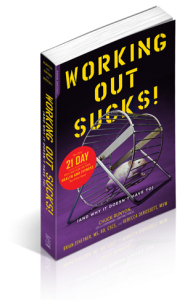
    working out sucksI’ve got three copies of Working Out Sucks! (And Why It Doesn’t Have To): The Only 21-Day Kick-Start Plan for Total Health and Fitness You’ll Ever Need to give away.

    To enter to win:

    I need you to comment on this post and hit me with an excuse you’ve given in the past for not working out.

    You can have a second entry:

    by tweeting I want to win #WorkingOutSucks and beat my excuses- and make @robinelton proud. You’ll need to leave me a second comment letting me know you did that because I forget stuff.

    Working out sucks, sure. Secretly blaming yourself because you know you could be better? Sucks more.

    Do yourself proud. Make your kids proud, your mom proud. Make me proud. I like feeling proud of people.

    __________________________________
    I’ll pick 3 winners at random at noon EST on Tuesday January 24th. But if you don’t win, think about picking up a copy anyway. 100% of net proceeds benefit Limbs for Life, a nonprofit which provides fully functional prosthetic care to those otherwise unable to afford it.

    __________________________________
    Disclosure: I’m Community Manager for FitFluential LLC (come tweet with me). Anytime Fitness is a client of FitFluential. The book I reviewed and the copies I am giving to readers were provided by the client. All thoughts and opinions in the post are my own.

    __________________________________

    Awesome photo courtesy of the Library of Congress through Creative Commons. “Hop” Harry Stone, “the American Newsboy Champion Lightweight,”  the second fighter in boxing history to have over 200 recorded fights without ever suffering a K0 or TK0 loss.