Category: Conscious Consumerism: Shopping & Reviews

  • Tube-Free Toilet Paper

    Tube-Free Toilet Paper

    scott naturals no tube

    The wrongs done to trees, wrongs of every sort,
    are done in the darkness of ignorance and unbelief,

    for when the light comes,

    the heart of the people is always right.

    -John Muir

    I heard about this forever ago, but I’ve never seen it “in the wild.” A few days ago we saw a commercial for it at the beach, and no one I was with knew about it, so consider this a post a PSA for the as-yet uninformed 🙂

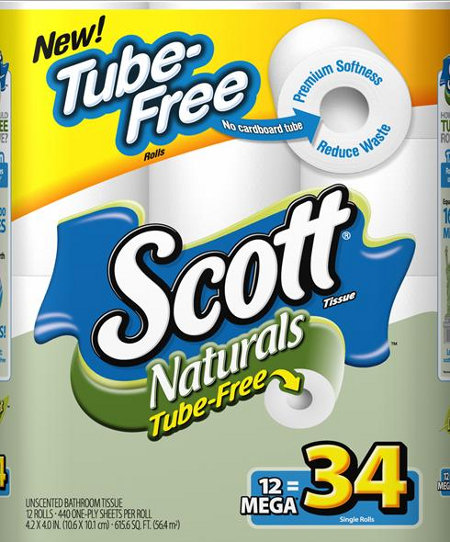
    Way back in October of 2010, Kimberly-Clark announced they’d be releasing a version of their Scott Naturals (40% recycled content) toilet paper that would be rolled without the cardboard tube. And a huge collective gasp came from the green community: huzzah! Brilliant!

    Because these are the innovations that make a huge difference. Everybody uses toilet paper. Eliminating the rolls not only conserves the natural and energy resources used to make an estimated 17 billion bath tissue tubes every year (equivalent to 160 million pounds of waste wiping American butts alone), it does so in a way that doesn’t cost any more money and requires no extra effort.

    So that maybe people will say, Hey! That wasn’t so hard! And I sort of feel good about it! What else can I do?

    I’m also thinking that, if the price is the same, most people will shrug and go with the eco-option for that feel-good feeling. As John Muir says, the instinct of the people is to do the right thing.

    Apparently tube-free is being market tested in Wal-Mart and Sam’s Club, which explains why I haven’t seen them in person. I’m not about to make a special trip to buy them, either, but I really hope they do well. The more people buy, the more the price will drop, and the more likely the other brands will see the green light and follow suit.

    If you do shop at Wal-Mart or Sam’s Club, there’s a $1 off coupon on the Scott site.

    And if you don’t, here’s an easy green step you can take today: recycle those TP rolls with your paper. According to a survey Scott Naturals conducted, more than 85% of people throw them out with the trash, which seems insane.

    Have you seen ’em? Will you buy ’em?
     

  • Over 60% of Car Seats Contain Toxic Chemicals

    Over 60% of Car Seats Contain Toxic Chemicals

    baby-carseat


    Kids need to be in car seats. Good ones.

    Every kid. Every time.

    Car seats save lives.

    So it really sucks to find out that more than half of car seats are exposing kids to toxic chemicals. Babies are particularly vulnerable since they are rapidly developing and tend to spend a lot of time in their seats (especially if, like mine, they slept well there).

    Also, keep in mind that the repeated heat-and-cool cycle and UV exposure inside cars can possibly accelerate and intensify toxicity. Happy happy, joy joy.

    The latest research, based on tests of over 150 car seats currently on the market (2011 models), was just released by the nonprofit Ecology Center. They tested for:

    Bromine: Associated with the use of brominated flame retardants (BFRs), which are added to plastics for fire resistance. Some BFRs have been associated with thyroid problems, learning and memory impairment, decreased fertility, and behavioral changes. A recent peer-reviewed study published in Environmental Science & Technology found a majority of baby products tested, including car seats, nursing pillows and baby carriers, contained chemical flame retardants either associated with adverse health effects or lacking adequate health information. Although fire retardants in foam are necessary to meet certain fire-safety standards, non-halogenated fire retardants are available, and many have a better safety profile. Brominated flame retardant chemicals that are either deemed toxic or that lack adequate health safety data were detected in 44% percent of the 2011 car seats tested. (NOTE: HealthyStuff.org did not test for all hazardous flame retardants, particularly chlorinated flame retardants (CFRs), and seats may contain other chemical hazards).

    Chlorine: Associated with the use of polyvinyl chloride (PVC), which is widely used in plastics and is of concern to the environment and public health during all phases of its life cycle. PVC contains chemicals called phthalates, some of which have been associated with decreased fertility, pre-term deliveries, and damage to the liver, testes, thyroid, ovaries, kidneys, and blood. There is also evidence that phthalates can pass from mothers to babies through the placenta and through breast milk.

    Lead: Lead is sometimes used as an additive in plastics. Exposure can lead to a number of potential health effects, including brain damage, learning disabilities, and problems with the kidneys, blood, nerves, and reproductive system.

    Other: Other chemicals tested as part of HealthyStuff.org include antimony, arsenic, chromium, cobalt, copper, mercury, nickel and tin. The substances in this category are allergens, carcinogens, or cause other adverse health impacts depending on the concentrations and exposure levels.

    It’s sort of amazing that we have something called the “Toxic Substance Control Act” in place but it doesn’t really seem to be doing much to control toxic substances, does it?

    Or that carseat companies think to cover car seats in flame retardants in the name of safety, but don’t check to ensure the flame retardants used are safe themselves.

    Anyway. That’s the bad news. Here’s the good news:

    • While 60% of the car seats tested contained at least one of the bad chemicals, many tested contained none at all. Score! Support those companies!
    • The Ecology Center first started doing these tests in 2008. In three short years, average rankings have improved by 64%. You know why? ‘Cause people care and companies will listen. Keep talking!
    • Generally speaking, I think flame retardants are probably a good call with car seats. There ARE safer flame retardants out there. Look for them and ask for them by name 🙂

    So here’s the best and the worst. Baby shower accordingly.

    Most Toxic 2011 Car Seats. Do Not Buy.

    Infant Seat:

    • Graco Snugride 35 in Edgemont Red/Black
    • Graco SnugRide 30 in Asprey

    Convertible Seat:

    • Britax Marathon 70 in Jet Set
    • Britax Marathon in Platinum

    Booster Seat:

    • Recaro Pro Booster in Blue Opal
    • Recaro ProSPORT Toddler in Misty

    Least Toxic 2011 Car Seats:

    Infant Seat:

    • Chicco KeyFit 30 in Limonata
    • Graco Snugride 35 in Laguna Bay (that color’s not listed on Amazon)
    • Combi Shuttle 33 in Cranberry Noche (ditto)

    Convertible Carseat:

    Booster Seat:

    I’ve linked the good ones, but you’ll still need to do your homework to figure out which fits your safety/ comfort/ convenience/ toxicity ratios.

    And even if you already own one of the more toxic ones, and can’t afford a new one, just remember ANY CAR SEAT IS A GOOD CAR SEAT. Oh my god, it drives me insane when I see cars on the road with kids cruising all over the backseat. Or sitting up front when they are CLEARLY too young. SAFETY FIRST.


    Check out www.HealthyStuff.org for the complete list of car seat rankings. And while you’re there, sign the petition asking Graco and Evenflo to disclose and phase out hazardous chemical flame retardant additives.

    They’re listening. Are you getting noisy?


  • Hot Dogs: As Bad As Cigarettes?

    Hot Dogs: As Bad As Cigarettes?

    hot dogs cigarettes

    Is the chemical aftertaste the reason why people eat hot dogs,
    or is it some kind of bonus?

    -Neil Gaiman

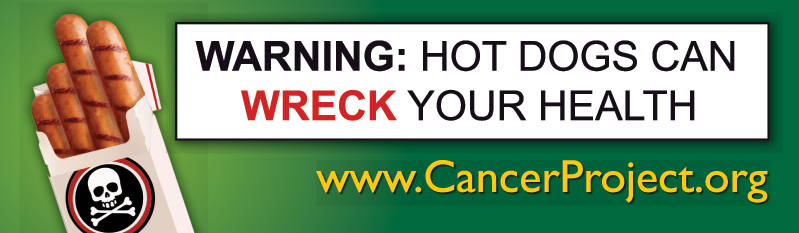
    The image above was posted as a billboard near the Indianapolis Motor Speedway, warning NASCAR Sprint Cup fans that hot dogs can kill.

    So of course, there’s all kinds of hoopla. People serve their families hot dogs all the time. It’s a lifesaver of a last-minute meal. Isn’t this sensationalist propaganda on the part of the foodie police?

    Well, yeah, maybe. But isn’t all marketing sensationalist propaganda?

    Here’s how I see it.

    • According to the American Institute for Cancer Research, just one 50-gram serving of processed meat (about the amount in one hot dog) consumed daily increases the risk of colorectal cancer, on average, by 21 percent.

    Now, most people aren’t eating a hot dog a day (I really, sincerely hope). But other processed meats are no good, either, and lots of lunches involve lunchmeat (including my personal nemesis, the dreaded Lunchables). And 21% is a lot of percents when it comes to cancer.

    Studies show a strong link between other types of cancer and processed meats.

    • An NIH-AARP Diet and Health Study found that processed red meat was associated with a 10 percent increased risk of prostate cancer with every 10 grams of increased intake.
    • A study in Taiwan showed that consumption of cured and smoked meat can increase children’s risk for leukemia.
    • A study in Australia found that women’s risk for ovarian cancer increased as a result of eating processed meats.
    • A review in the journal Diabetologia found that those who regularly eat processed meats increase their risk for diabetes by 41 percent.

    “But I buy the all-natural, nitrate-free hot dogs, like Applegate Farms.”

    Sorry, Charlie. I’ve got nothing against Applegate Farms specifically, it was just the brand that popped into my mind, but their all-natural label just means that their nitrates come from a natural source (celery powder or celery juice).

    In reality, natural hot dogs may contain anywhere from one-half to 10 times the amount of nitrite that conventional hot dogs do.

    The president of the National Hot Dog & Sausage Council counters that “trying to link a food product that has clear nutritional value with a product like cigarettes, which have no redeeming qualities, is inflammatory and alarmist.”

    Ex-squeeze me? Clear nutritional value? Are you serious? Does anyone think hot dogs are good for them?

    Here’s what makes up a hot dog: meat by-products and fat, seasoning (salt, garlic, paprika), and preservatives (usually sodium nitrite).

    So what’s a meat by-product? Trying to nail down exactly what by-products are allowed in a hot dog, as opposed to, say, dog food, is a slippery proposition. The best I can do is from the USDA website: “semisolid products made from one or more kinds of raw skeletal muscle from livestock (like beef or pork), and may contain poultry meat.”

    That vagueness is enough to make me not want a hot dog, frankly. I don’t love them anyway and I’m not gonna miss them. For the kids, we’ll treat them like any other indulgence– maybe once in a blue moon, when we’re actually at a major league ball game or at a county fair.

    Listen.

    About 143,000 Americans are diagnosed with colorectal cancer annually and about 53,000 die of it. Painfully.

    My dad was one of those.

    I don’t know. There are some risks worth taking. I don’t think this is one of them.

    The taste of a hot dog just isn’t worth it to me.

    Thoughts?

    source