Category: Conscious Consumerism: Shopping & Reviews

  • Review & Invitation! OMRON Strapless Heart Rate Monitor

    Review & Invitation! OMRON Strapless Heart Rate Monitor

    Don’t go breakin’ my heart…

    (I won’t go breaking your heart)

    -Elton John & Kiki Dee

    As I mentioned in my post about GNC, when I was a kid we walked everywhere. EVERYWHERE. School was about a 10-block walk (that I would walk by myself, mind you). Want groceries? Only about 8 blocks, but then you gotta carry the groceries back (we had one of those steel shopping carts).

    We’d walk the six miles to Brandywine Creek State Park so we could then HIKE the trails and walk back… and that was a fairly typical “fun outing” for us.

    I also played sports— softball, basketball, ice hockey, skating, bowling. I biked a lot, too. Basically when it was too far to walk.

    I had a great metabolism that I always attributed to genes, but in hindsight probably was also shaped by the exercise that was just built into my daily life. When the genes started to turn their back on me with age, combined with the weight gain associated with 3 pregnancies and the sedentary life of a freelance “content producer” on the interwebz, I had to concede that metabolism wasn’t going to magically help me out and I was gonna have to do the work.

    Traditional “exercise” like treadmills, the elliptical and such… was all new to me until I joined the Y. And every time the heart rate count popped up on the machine, I would get panicky, because doesn’t that number seem really high?

    I figure I can’t be the only person that isn’t armed with this knowledge. So:

    220- (your age, in my case 35) = Maximum Heart Rate or MHR (for me, 185).

    • For health maintenance, you want to regularly hit 65%-78% of that (121-144). Good for beginners and strengthening your cardiovascular system.
    • For increasing strength, endurance and calorie burn, Aerobic Exercise is 65%-85% (121-157).
    • At 78%-90% (144-167), you’re improving speed and power.  Anaerobic Exercise builds muscle faster, but can’t be sustained for long periods of time.

    That’s good stuff to know, right? No more driving up your heart rate just because you’re worried about your heart rate.

    BUT, like before, much of my exercise takes place here at home or out and about, not in the gym.

    How do I know what my heart rate and resulting calorie burn is when doing everyday stuff, like playing soccer or basketball?


     

    playing soccer

    How about yardwork or shoveling snow to make Das Terminator?

    clearing sticks

    shoveling snow

    How about walking the dogs… or riding mechanical bulls…

    How about when we jump around? Jump up, jump up, and get down?

    (I do actually do most of these things, no one takes pictures of me. I didn’t get on the mechanical bull because it was for the kids but BOY DID I WANT TO.)

    My point is, there are more ways to get fit than join a gym (although the gym yields the fastest & best results for me). Consistent bouts of movement, of varying kinds, throughout the day, achieving an elevated heart rate of ideally 65%-85% of your MHR.

    The next question is: how do you know you’re achieving your target heart rate?

    The rule of thumb seems to be if you’re out of breath: still able to talk, but too winded to sing.

    For the numbers-oriented among us, a more scientific approach would be using a heart rate monitor. Apparently these things usually involve a chest strap, which I’m gonna say would be a deal-breaker for me, as I use mine primarily to chart my heart rate outside the gym (inside the gym, I’ve got the machines telling me). Also, I suspect I would look stupid.

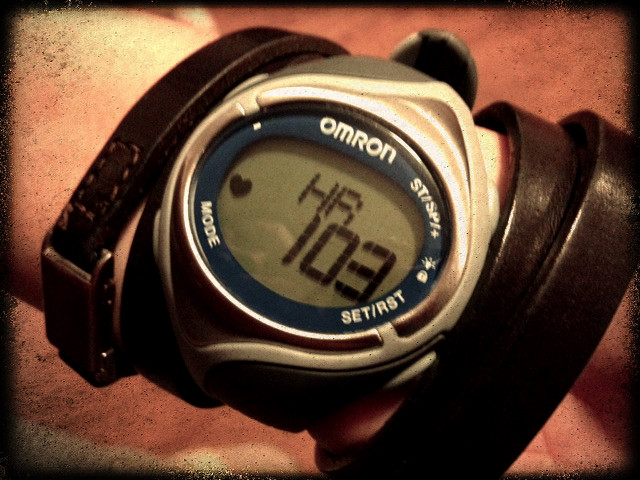
    The OMRON HR-210 Strapless Heart Rate Monitor that I was sent to try out is, well, strapless. As in no strap. It also:

    • has a thing that tells time… hey, remember watches? 🙂
    • is water-resistant up to 164 feet (this is awesome; I’m forever forgetting to put my FitBit back on after showers)
    • has a stopwatch/timer
    • OMRON Sensor Technology: easy, accurate results in six seconds from just two fingers
    • Zone Alerts: programmable zones warn you if you’re too high (and presumably your heart is about to burst) or too low (so you can step it up)
    • tells you calories burned for better feedback and gratification.

    I’m also very picky about what I wear and I think it looks kinda badass with my leather wraparound bracelet.
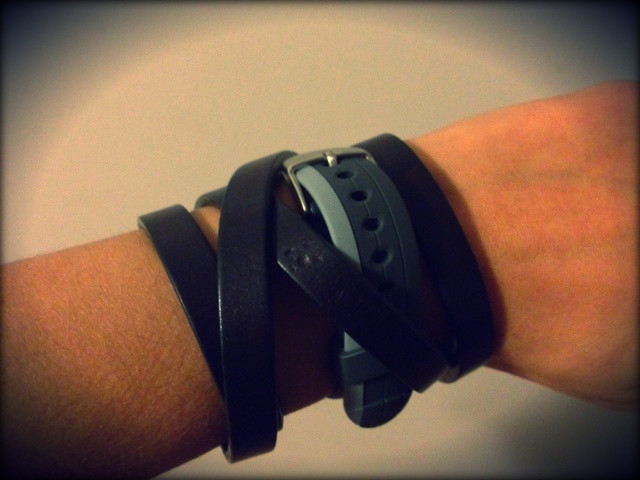
    omron heart rate monitor


    Note: I wear the face on the underside of my wrist and it works just fine that way.

    I know when I wear a pedometer I remember to take more steps, and if I’m coming in low for the day I try to make it up before going to bed that night.

    In the same way, tracking my heart rate and calorie count makes me aim for that sweet spot much more than I would normally (a few jumping jacks while waiting for a page to load, anyone?).

    In a country where not a single state has an obesity rate less than 20%, where kids spend an average FOUR FREAKING MINUTES DAILY playing freely outside… every little bit helps.

    If you’ve resolved to live a heathier 2012… or to make 2012 more like 1992… this is a nice motivator. A fun gadget. A handy little thing to have. An education in self- awareness. Plus, hell, a WATCH. (Much more socially acceptable to be checking in the middle of a practice than an iPhone. Trust me.)

    The OMRON HR-210 can be purchased here for $49.99.

    ______________________________________

    Invite!

    Party party! We’re having a Twitter chat with @OmronFitness tonight at 9pm EST. Hashtag is #fitwithomron. Come talk to us about getting started MOVING that body! I’m the loudmouth behind the @FitFluential handle. AND we’re giving away TWO monitors!

    Details here.

    ______________________________________

    Disclosure: I work for FitFluential LLC and Omron is a client. I received a heart rate monitor for review purposes. All thoughts and opinions are my own.
  • Check It: Vinegar and Baking Soda in the Cleaning Aisle

    Check It: Vinegar and Baking Soda in the Cleaning Aisle

    cleaning with baking soda

    A man builds a fine house;

    and now he has a master, and a task for life:

    he is to furnish, watch, show it, and keep it in repair,

    the rest of his days.

    -Ralph Waldo Emerson

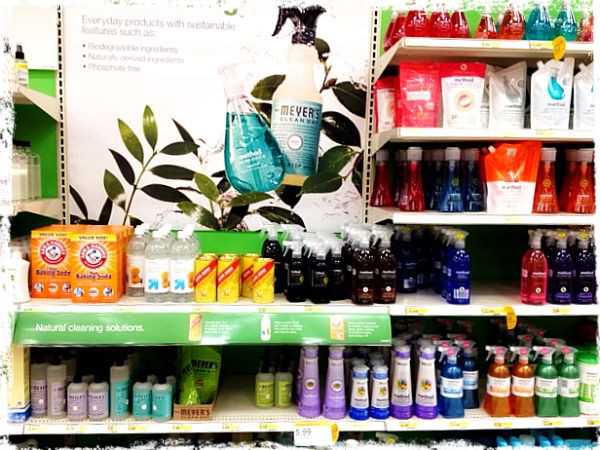
    We went to Target to get a desk for Cassie (Jeff built her a nice “office” to try and keep her craft detritus contained to her room) and I grabbed some (organic!) chicken and yogurt for the kids. Opposite the fridge aisles is an aisle dedicated entirely to eco-cleansers… and right smack in the middle of the Methods and Seventh Gens and Mrs. Meyer’s?

    Baking soda, white vinegar and Bon Ami!

    While cleaning with baking soda and white vinegar has become a common notion on the internet, it was pretty surprising to see a huge chain like this acknowledge that. Not even my co-op does this… I just thought it was super cool and I hope it reflects a changing consumer attitude about cleaning products. After all, no store does anything without thinking it will mean a $$ return for them. Presumably this is what customers wanted! (And of course, means they will eyeball all those other ‘green’ cleaning choices available. I don’t really have a problem with that.)

    Have you seen any stores doing this?

    Or is my specific Target eco-awesome?

    ____________________________________________

  • Getting into the (Eco) Spirit: ‘Green’ Beers, Wines, Alkie-hol

    Getting into the (Eco) Spirit: ‘Green’ Beers, Wines, Alkie-hol

    Wine is sunlight, held together by water. 

    -Galileo


    After guest posting on Type-A Parent about having a green, sustainable Christmas, I got a bunch of questions about eco beers, wines and spirits. I guess it’s an arena that some people hadn’t really considered greening before.

    Like anything on the green-eco-sustainable front, it’s a sliding scale of factors, and you will need to ultimately decide which ones matter most to you. Some liquor might fit all your needs, which is awesome, but I’m thinking there’s a small selection of “perfect.”

    I haven’t done a ton of research, I’m letting you know that upfront. This is just a down-and-dirty mind dump. More thorough resources are at the end.


    1. Is it organic?

    Imported grapes made it onto EWG’s 2011 Dirty Dozen list of fruits & veg you should buy organic, and a whole lotta grapes go into making wine. Like apple juice, we’re talking about a concentrated liquid, and that means concentrated toxins.

    Beer is made from barley and hops (and wheat if we’re talking wheat beer). There is a lot of pesticide and fungicide used (particularly with the hops), although I don’t believe it’s absorbed to the same extent a grape absorbs. Currently, a beer can be labeled organic if the barley/wheat was grown without chemicals but not the hops; this is being phased out and by 2013 an “organic beer” will be all organic ingredients.

    As always, my reminder here is that the real reason to buy organic is to limit not only our own chemical exposure but the impact those chemicals have on our soil, on our water supply, and on the farmers that have to handle it. Buying organic is more expensive, yes, but demand is how we collectively drive down price.

    2. Is it local?

    Liquids are expensive to shuttle around. They weigh a lot and have a large carbon footprint. Go domestic over imported, local over shipped from the other side of the country.

    Bonus points for small family-owned biz.

    3. How’s it packaged?

    There’s an up-and-coming trend of putting craft beers in cans that I don’t love; the idea is that it makes them more portable but should you be taking your alkie-hol hiking or on the road with you anyway? However, the lighter aluminum makes a difference in shipping weights and carbon footprint; we’re talking up to 30% less emissions.

    Apparently, aluminum also tends to get recycled more than glass, and glass requires more energy at first formation. BUT, glass is infinitely recyclable.

    (It’s a given that you’re recycling, right?)

    I can’t even start to wrap my head around how best to meaningfully crunch those numbers, but it looks like cans come out on top.

    Until you remember that the cans have an inner lining to keep beers from developing a metallic taste, and to me it seems like linings always turn out to have BPA involved.

    I’ll leave you to make your own decision, but if you’ve got local beer on tap at the corner pub? YOU WIN.

    4. Is the company sustainable?

    Are they recycling their byproducts? Do they use alternative, clean energy? How do they treat their workers?

    Do they make donations to charities you support? I have to give a shoutout to ONEHOPE wine, here. They donate half their profits to charity and YOU get to choose who gets the portion of YOUR purchase.

    I know these are pain-in-the-ass questions, but if you’re like me you’re already loyal to a few labels. Check them out. Remember that these issues matter to companies if they matter to YOU, because you vote with your dollar. And believe me, companies want your dollar.

    That doesn’t just go for liquor, folks.

    So what does Robin drink?

    Paradocx Wine

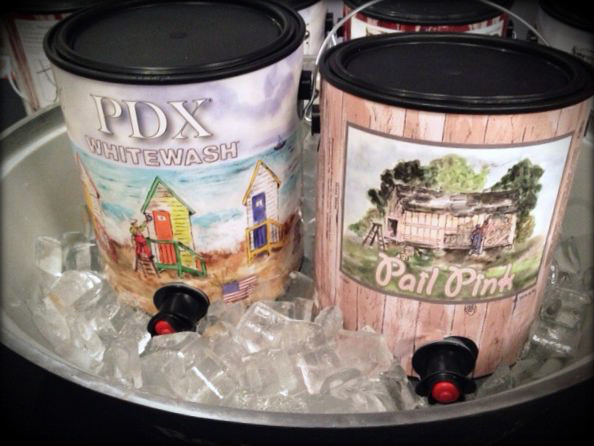
    I don’t drink a helluva lot of wine, but when I do it’s from a family-owned & operated local vineyard right here in Landenberg (I drive past it on the way to Jake’s school). It’s not organic, but is on a small-enough scale that I hope they don’t find broadly spraying necessary. They use drip irrigation rather than soaking for water conservation. And their wine is packaged in paint cans; when you finish your can you can turn it back in to be reused.

    They also run a CSA— if you’re local and into wine you should look into it. I like the white and the blush, but that’s not saying much; I don’t like any red wine that I can think of.


    local wine


    Blue Moon Beer

    I heart my Blue Moon. It’s not local but it’s my favorite. It’s brewed and packaged in Denver, and frankly I trust people in Colorado. I’ve been there and they take their eco-sensibilities seriously.

    It’s tough to tease out any info about Blue Moon as an individual operation, as it’s owned by MillerCoors:

    Striving to make more beer while using less water, reusing or recycling nearly 100 percent of brewery waste, it relies on each of its U.S. breweries to seek out the most efficient and environmentally sustainable brewing practices.

    It also tastes really good.

    blue moon beer
    Just an ordinary night, drinking my Blue Moon and hanging out with the potted plant. In the hallway.


    Beer Runner-Up— Sierra Nevada Pale Ale

    Not local. I should really get out and try some more local beers (mostly I just never buy beer when I’m eating out because it’s so expensive that way).

    Sierra Nevada is powered by solar and hydrogen fuel cells; if you go to their website you can see how much energy is being produced by either right now. It’s kinda neato.

    Death’s Door Spirits

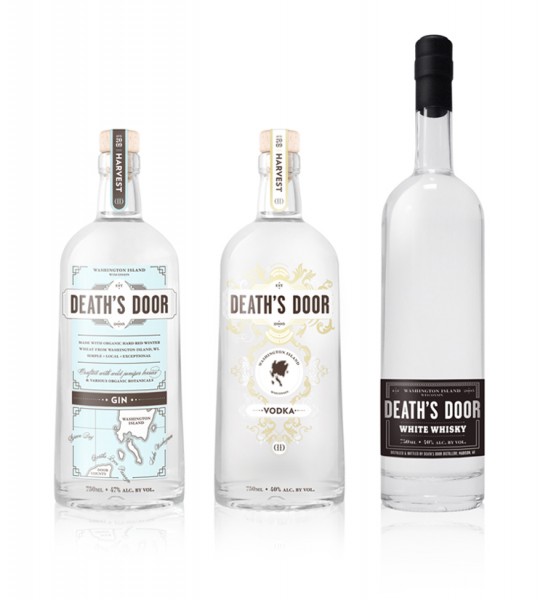
    I was introduced to this brand when visiting the Green House in Boulder. The vodka is straight up yum, described as “smooth and rich with subtle notes of vanilla.”

    Since 2005, Death’s Door Spirits and Capital Brewery have supported the farmers’ efforts on Washington Island to expand the acreage of hard red winter wheat from five (5) to 1,200 while two years ago organic certification was achieved for all of the crops.

    The wheat and barley are organic, the juniper berries are wild, and the ingredients are locally sourced to support local & small biz and to reduce overall carbon footprint. AND their stuff is tasty AND their bottles are kickass. Also? DEATH’S DOOR. Love the name.


    To ring in the new year, I have to share my favorite drink of the moment (pictured at top).


    Death’s Door Pomegranate Lemonade

    • pomegranate juice (I buy Wild Harvest, which is Acme’s house brand for organic)
    • equal amount lemonade (I use Newman’s Own Pink Lemonade; organic and the pink comes from grape juice)
    • a healthy dose of Death’s Door vodka

    Antioxidants in the pomegranate! Profits from Newman’s Own going to charity! Supporting small farms! All organic, baby! This drink is full of WIN.

    You can’t even taste the alcohol; if anything this vodka adds a touch of sweetness to balance the tartness of the pomegranate and lemonade. Which can be a good thing or a VERY VERY bad thing.

    Don’t drink and drive, people. This one creeps up on you.

    Ever think about the pesticides in your alkie-hol?

    Will you look for the organic label now? Support local? Look for sustainability?


    ________________________________________


    Further Reading:

    Which Kind of Booze Is Best for the Planet?

    Organic Beer and Beyond: 10 Eco-Friendly Breweries

    Green Booze: List of Eco Alcohol