Category: Fitness, Health, Happiness

  • Blue Diamond Almonds: A Heart-Healthy Food. Who Knew?

    Photobucket
     

    Seemingly, everybody. But me.

    Ever discover something new and exciting only to realize the whole world got the memo two weeks ago?

    That was my relationship with Dooce. I came across Heather Armstrong’s blog from a Google search. I read for an hour, and thought, this woman and I could be friends. We are totally the same kinda people. I almost sent her an email to that effect. Turned out, she’s only the most famous mom blogger in all of existence.

    Oops.

    I bought some almond milk on a whim last week after seeing some blog posts about it. I have issues with milk, so I usually try to make up the calcium with cheese and yogurt and cruciferous veggies. You know what? Dang, almond milk is tasty. I had cereal with milk for the first time in decades. BOOM. Easy calcium.

    It was sort of awesome.

    Maybe I live in a cave or something- did you know you can buy almonds in different flavors? Real flavors, not just honey roasted vs dry roasted like peanuts. I picked some Blue Diamond Almonds up, taking the Roasted Salted and Smokehouse almonds for a test drive (literally. I left the cans in the car for emergency snacking). Really super good, people.

    So I’ve been all enthusiastic and trying to talk about this new milk replacement/snack choice… and everybody else is like, are you for real? Yes, almonds are good. I’ve known that since I was knee high to a grasshopper.

    OK, wise guy. Did you know this?

    • A serving of almonds is a handful, or 23 nuts, which is a pretty impressive snack if you don’t shove the whole lot in your mouth at once.
    • They’re full of good stuff like monounsaturated fat (that’s the the good kind, and it may be good for brain health and memory, too), fiber, vitamin E, calcium and other important minerals, and phytochemicals (which might help protect against some common diseases).
    • They have a high protein content, which aids in lean muscle development, works to fuel my running, and generally helps you feel fuller, longer.

    Not bad for something I can use to satisfy that urge for something crunchy (chips have always been my downfall).

    Almonds are heart-healthy

    PhotobucketAlmonds are such nutritional powerhouses that the American Heart Association (AHA) has certified a variety of Blue Diamond Almonds as heart-healthy.

    You can find the AHA Heart-Check mark on the packaging of:

    • Whole Natural
    • Roasted Salted
    • Low Sodium
    • Sea Salt
    • No Salt
    • Honey Dijon

    meaning that these almonds have met specific guidelines set forth by the AHA. Specifically for nuts it means:

    Total Fat: No limit
    Saturated Fat: 4 g or less (per 50 g only)
    Trans Fat: Less than 0.5 g (also per label serving)
    Cholesterol: 0 mg per label serving
    Sodium: 140 mg or less (also per label serving)
    Beneficial Nutrients: 10% or more of the Daily Value of 1 of 6 nutrients (vitamin A, vitamin C, iron, calcium, protein or dietary fiber)

    Keep in mind that heart disease is American’s number one killer. Which is depressing because heart disease is completely preventable by following some common sense measures: eating better, moving more, maintaining a healthy weight, improving your blood pressure and cholesterol levels.

    Can snacking on almonds make that much of a difference?

    Well, maybe. I think this is fascinating.

    One study that I thought was fascinating found that subjects, when asked to turn to almonds as a snack instead of a less healthy option but given no other diet restrictions, opted for healthier food choices in addition to and independently of the required almond snacks. Their levels of good things like fiber and vegetable protein increased, and their overall levels of bad things like trans fats, cholesterol and sugars decreased significantly.

    The implication is that if you swap less healthy foods for almonds as a snack, you’re more likely to become the sort of person who will opt for other good-for-you foods. Pretty cool, right? I’ve read about similar conclusions when it comes to vitamins: if you take them regularly, the real health benefit may be less about the specific supplements received and more about how you become the sort of person to make choices that positively impact your health.

    This goes back to my discussion of how a healthy diet and lifestyle is analogous to the green lifestyle: it all starts with one small change. Then another. You keep building until it becomes second nature, and before you know it, you’ve become an eco warrior. Or you’ve managed to lose 25 pounds by making a bunch of small changes.

    So that’s my latest small change. Snacking on almonds and increasing my calcium intake and cereal enjoyment with almond milk. A simple step with surprising health benefits.

    Wanna learn more about the health benefits of almonds and get some cool almond recipes?

    FitFluential is holding a #BlueDiamond chat on the Twitter tomorrow night, 5/21, at 9EST. Join us! Prize details are still a secret, but I hear they are awesome.


    Blue Diamond Growers have been growing almonds in the US of A for over a century. There are over 3,000 California almond growers shipping their deliciously nutty wares all over the world. If you haven’t discovered the joy of almonds yet, check ’em out on their website, on the Facebook and of course on your grocer’s shelves.

    Disclosure: I’m the VP of Community over at FitFluential and the woman behind the curtain… er, @FitFluential handle. Blue Diamond is a client but I bought my own almonds and almond milk with my own cash moneys. My opinion is my own and springs from my own brain, whole and fully formed, much like Athena from the brow of Zeus.


  • 10 Health Benefits of Sunshine – Get OUTSIDE!

    10 Health Benefits of Sunshine – Get OUTSIDE!

    Photobucket

    The sun does not shine for a few trees and flowers,
    but for the wide world’s joy.

    Henry Ward Beecher

    May is Skin Cancer Awareness Month.

    Skin cancer is the most common of all cancers, afflicting one in five Americans (one in three Caucasians) and accounting for nearly half of all cancer cases in the US.

    It only takes one blistering burn to increase your risk of skin cancer.

    And kids and teens are especially at risk, as they’re more likely to seek out sunshine year round.

    That being said, it’s also important that we don’t overreact and keep them indoors any more than strictly necessary. The average American kid spends just 4-7 minutes daily in unstructured outdoor play, a factor that has been tied to childhood obesity, stress, falling fitness levels and decreasing learning ability.

    In addition, the sun and the vitamin D it supplies contain their own health benefits.


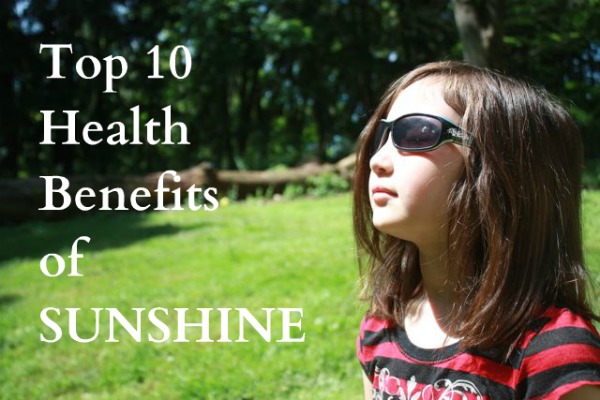
    Top 10 Health Benefits of Sunshine

    1. Reduce risk of Type 2 diabetes. Once considered an adult-onset disease, type 2 diabetes is reaching epidemic proportions in our kids. It’s a lifelong disease, and harder to treat in the young.  Some studies suggest that vitamin D can reduce the risk of developing it (one study found that those with high levels were 40% less likely than those with low levels).

    2. Reduce cancer risk. There are lessened mortality rates for 15-20 types of cancer in regions of higher solar UVB exposure, particularly for breast, colon, and rectal cancer. Those patients who had higher vitamin D blood levels when diagnosed had nearly twice the survival rate of those with the lowest levels.

    3. Strong bones for better bone health. Vitamin D boosts calcium absorption for strong bones, which means you’re less likely to develop bone diseases, fractures and osteoporosis.

    4. Protect eye health. Vitamin D has been tentatively linked to lower incidence of cataracts, and studies indicate good D levels correlate to a lowered risk of macular degeneration as you age.

    5. Boost immunity. Researchers believe that vitamin D is integral to proper function of the body’s T cells— the immune system’s first line of defense.

    6. Improve metabolism; fight obesity. Several studies show correlation between sun exposure and an increase in metabolism, although the reasoning isn’t cut and dry. One hypothesis that makes a lot of sense to me is that decreased time in the sun leads the body to believe it’s winter, causing the body’s metabolic processes to shift into a winter fat-storing mode. More about that here.

    7. Lower blood pressure. The warmth of the sun can improve circulation, and heightened vitamin D levels have been shown to reduce blood pressure in hypertensive subjects— perhaps as effectively as medication.

    8. Reduce stroke risk. There are likely a lot of factors at work here, but in one survey people who lived in areas with less sun exposure had a stroke risk that was 60% higher than those who lived in sunshine-y regions.

    9. Sleep better. Daily time in the sun helps to regulate circadian rhythms for a better night’s sleep. And sleep has its own host of health benefits.

    10. Feel better. Sunshine has been shown time and again to improve mood, fight Seasonal Affective Disorder and lessen stress. Not to mention, we’re more likely to MOVE when we’re outside basking in the sun. And physical activity is definitely good for you!

    Vitamin D deficiency is also implicated in a lot of other health complaints, from muscle pain to the resurgence of rickets (!) in children.


    Is vitamin D from sunlight better than taking supplements?

    Well, it’s complicated. Current health recommendations lean toward limiting sun exposure, a logical conclusion when you take into account the incidence of skin cancer.

    However, given that vitamin D deficiency is one of the most common nutritional deficiencies (some say the most common, while others give that distinction to iron) and the many ways D is beneficial for the body and mind, I’m championing sunshine, enjoyed responsibly, supplemented by diet.

    Here’s why:

    • 400 IU of vitamin D per day for infants and between 600 IU and 800 IU for adults is recommended, depending on age. Your body can produce that in minutes with sun exposure.
    • We evolve slowly over time. Our bodies are made to synthesize vitamin D from sunlight, forming D3, which has hormonal advantages over other forms of vitamin D.
    • D3 is also better absorbed than other forms. More evidence that our bodies optimize what we receive from the sun, because we have evolved that way.
    • You can overdose on D in supplement form (D2). It’s nearly impossible to do that from sun exposure and diet— your body can tolerate enormous amounts of D3, probably because the body is capable of producing so much when allowed to. Chalk up another one for all-natural.


    The solution? It’s so easy.

    GET OUTSIDE MORE.

    Wear your sunscreen— no sunscreen blocks 100% of the sun’s rays— but make a point of frequently getting out there to get short doses of golden sun.

    Take frequent breaks to stretch your legs and breathe in some fresh air.

    Go for walks.

    Play at the park with the kids.

    Garden.

    Whatever. You’ll get more vitamin D. You’ll be moving more and sitting less. You’ll be pumping fresh air into your lungs instead of the still, chemical-laden air of our sealed-up buildings. You’ll enjoy the mental benefits of communing with nature and taking a break.

    It’s win-win-win-win. And then win some more.


    Some months out of the year, it’s tough to get enough sunshine— which can lead to Seasonal Affective Disorder. Learn the symptoms and how I cope with it here.


  • Natural Non-Toxic Sunscreen: Beyond Coastal Review and Giveaway

    Natural Non-Toxic Sunscreen: Beyond Coastal Review and Giveaway

    Photobucket
     

    I’m gonna soak up the sun
    Gonna tell everyone
    To lighten up

    I’m gonna tell ’em that

    I’ve got no one to blame
    For every time I feel lame
    I’m looking up

    I’m gonna soak up the sun

    -Sheryl Crow

    These are my very favorite days of the year, when the air is still somewhat cool but the sun is deliciously warm on my bared shoulders. It feels new and luxurious, and the promise of an entire summer basking in the sunshine unfurls ahead of me.

    Of course, we’re past the days where we could just bask. Skin cancer is the most common form of cancer in the US, affecting one in five (one in three Caucasians). More than 90% of all skin cancers occur due to sun exposure.

    Just five lifetime sunburns or one blistering burn doubles your chance of melanoma, and kids, with their tender skin and tendency to seek out the sunshine, are especially at risk.

    Complicating things is the recent revelation that some sunscreens may actually CONTRIBUTE to your cancer risk, as they chemically change your skin, break down in sunlight and throw off free radicals.

    It’s really important to make sure you and the kids are fully protected whenever you are outdoors for an extended period of time (which you should do a lot! Getting outside in the sunlight and MOVING is healthy in so many ways!).


    Photobucket

    Our favorite ways to get outside and soak up the sun:

    • Soccer! Football! We’re on the fields 3 afternoons a week (sometimes 4) and alllllll day Saturday.
    • Basketball. I love me some hoopin’.
    • Playtime at the park. Cass and Mav hit the playground while Jake skateboards and I run, 3 times a week.
    • Hiking to the creek and skipping stones.
    • Break out the bikes!
    • Backyard picnics
    • The pool and the beach
    • Frisbee (you know how I love my Frisbee baseball)
    • Hanging out at the farmer’s market
    • Outdoor concerts
    • Just lying in the grass. And nothing-doing.

    I’m veddy veddy picky about the sunscreens we use. It’s an ongoing struggle to find something that Cass can wear without burning, that won’t cause my hands to break out in hives or anger Jake’s eczema, is relatively sweatproof (we are sweaty people), doesn’t cost a small fortune and isn’t a huge pain in the arse to apply.

    Not asking much, right?

    I have a very short list of sunscreens that make the cut that maybe I’ll make into its own blog post, but today I’m talking about the latest one that made the grade: Beyond Coastal.

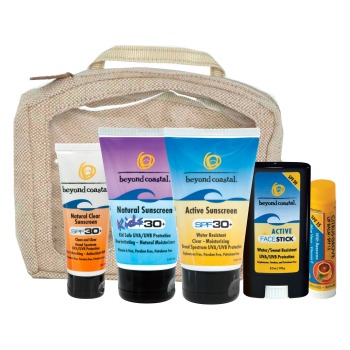
    Beyond Coastal Sunscreens are:

    • Photobucketgluten free
    • cruelty free
    • fragrance free
    • oxybenzone free
    • nanoparticle free
    • paraben free
    • oil free
    • reef safe and biodegradable
    • full of moisturizers and antioxidants
    • made with the outdoor athlete in mind
    • manufactured in the USA with renewable energy
    • top rated by the Environmental Working Guide and rated well for health on the Good Guide

    And effective. Cass wore the Kids Natural sunscreen on the (shadeless and hot as hades on a cloudless day) athletic fields all day, through playing a sweaty 8:30am soccer game and watching her brother’s game in the midday sun, then running around with her toddler cousin in the yard, without a hint of pink on her fair skin.

    With my sensitivity to fragrance and tendency to break out in hives, I was most concerned with those factors, and the Active sunscreen suited just fine. The scent is light and I kinda like it. No irritation, no hives, none of that really heavy sticky feel— I wore it running and I didn’t feel totally disgusting afterwards (well, no more so than usual).

    Best feature from a mom standpoint, aside from the skin safety? Cass didn’t mind putting it on her face (usually a bitter battle). The deoderant-stick-tube made it easy for her to put it on herself, and she actually commented on how it didn’t hurt when she put it on her eyelids (good girl! I tend to forget eyelids, but she remembered because it’s her least favorite part).

    Photobucket


    Giveaway!

    beyond coastal natural sunscreenWe’ve got a Beyond Coastal prize pack to give to one reader, to help keep their family sun safe as they get outside. Just follow the directions in the Rafflecopter widget to enter: there are up to 12 possible entries, use as many as you like 🙂

    Be sure to check out the Beyond Coastal website; they’re offering 25% off your order when you sign up for their newsletter, and free shipping for the month of May (it’s Skin Cancer Awareness Month). Keep up with future deals by “liking” the Beyond Coastal page on Facebook.

    a Rafflecopter giveaway


    Disclosure: I received Beyond Coastal sunscreen products through Global Influence to try out for review purposes, and the company is providing another set for giveaway. I received no other compensation and as always, all opinions are entirely my own ramblings, based on thorough and repeated use.