I go to nature to be soothed and healed,
and to have my senses put in tune once more.
–John Burroughs
A few months ago the NYT ran an article about how pediatricians are considering writing prescriptions for produce: vouchers for fruits and vegetables that could be redeemed at local farmer’s markets. This had the dual perks of making fresh produce more affordable, while bringing new customers and dollars to small farmers.
I liked this idea. I haven’t really heard anything about it since.
Now, a new federal program that hopes to be an “Rx for healthy living” supports doctors who write “nature prescriptions” for kids who are obese or at risk for childhood obesity (and all the health problems that ride on obesity’s coattails: diabetes, heart disease, high blood pressure, and the like).
I like this idea too. I really hope it doesn’t fizzle out like the produce by prescription.
The theory is that these “prescriptions” will carry a weight that general advice and, you know, common sense do not.
The federal funds are supporting programs that train rangers and volunteers who take the patients with prescriptions on guided hikes. Which is all well and good and all, but for programs like this to work, we really have to somehow reintegrate nature into our children’s everyday lives in a more accessible way. Long, aggressive hikes on the weekends is not the ideal solution; and for some kids, may prove more discouraging than anything else.
My hope is that this program will gain enough steam that those funds will also be used to create more open urban green spaces, to provide access to nature at schools, so that kids can experience outdoor time in a natural environment every day, even if their time spent is of less aerobic intensity.
Health is a state of complete physical, mental and social well-being,
and not merely the absence of disease or infirmity.
-World Health Organization, 1948
How can spending time in nature combat childhood obesity?
Spending time in nature reduces stress.
Studies indicate that chronic stress may cause long-term metabolic changes that contribute to stubborn weight gain, particularly in the belly. (Abdominal weight gain in particular carries health challenges that are known to be killers.)
Spending time in nature generates a sense of well-being.
We can extrapolate the opposite to be true- that being deprived of nature can contribute to depression, and comfort eating. There have also been indications that lack of access to nature can be correlated to poor impulse control.
Spending time outdoors helps you sleep.
Exposure to bright daylight regulates your circadian rhythms. Meanwhile, the artificial light emitted from electronics suppresses the sleep-promoting hormone melatonin. The more time spent outside means the more time away from those rhythm-disrupting lights (exercise helps too, of course), promoting better sleep habits and quality sleep cycles. And, you guessed it: lack of sleep has been linked to childhood obesity.
Spending time outdoors may reduce allergies.
This one is a bit more tenuous, I’ll admit, but I want to include it. The “hygiene hypothesis” suggests that allowing our kids to get dirty— by which I mean outside and in actual dirt— helps their immune systems to develop whatever they need to fight off allergies. Children who are obese are more likely to have allergies, particularly to food. It’s a chicken or the egg sort of link and not necessarily causal (will preventing obesity prevent allergies? Or vice versa? Or do they come together as a matched set?) but since I’m emptying out my file of studies here I thought I’d include it.
Why aren’t school & neighborhood playgrounds as good as open green spaces?
Playgrounds can be stressful.
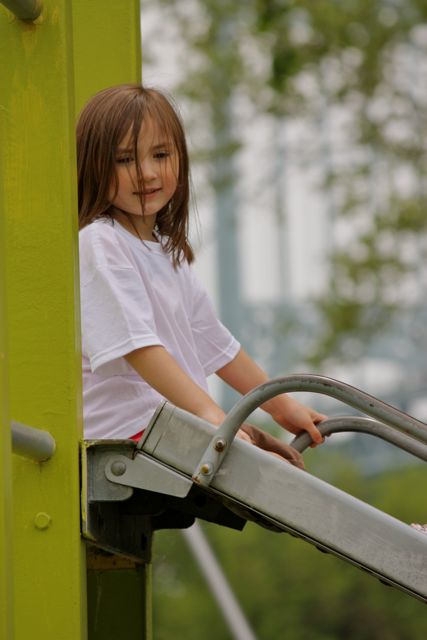
Ask any teacher. Slides, swings, and monkey bars don’t lend themselves naturally to cooperative play. With slides, it’s who can get there first; swings, who can swing the highest (and who is brave enough to jump off, causing any adults in the area to go into cardiac arrest, in spite of the fact that we did it as kids and survived); with monkey bars, it’s who can navigate them the fastest. And then of course there’s the fact that only so many kids can use the playground equipment at one time.
With natural spaces— ideally incorporating trees for climbing, rocks for scaling and hopping, and an incline of some sort for sliding and running down— there’s no clearly delineated race or competition. Kids can detach from the group without it being painfully obvious. Activity levels are determined by whatever play dictates; it’s not the same sort of hamster-on-a-wheel, ‘up-the-ladder-down-the-slide as many times as possible before the bell rings’ frenzy.
Playgrounds can be dangerous.
And not for the reasons that overbearing parents have conjured up in their overactive imaginations. Playgrounds assume a certain level of physical prowess that not every kid possesses. And then it takes these kids of differing levels of ability and confidence, and throws them all on the same equipment for an ever-shortening period of time. As I said before, recess can take on a frenetic quality as kids attempt to squeeze as much as they can into the time allotted to them. For a child who is nervous about climbing the rope ladder to the slide, this can be overwhelming at the least, as the more capable kids race and swarm around them, or dangerous at worst, as they lose their balance. Likewise, a kid who can’t make it across the monkey bars not only faces public humiliation when they stall, but has to deal with how to get down. Their only option is falling, FYI. There’s no safety net.
It’s just easier to not bother in the first place.
Green spaces build confidence.
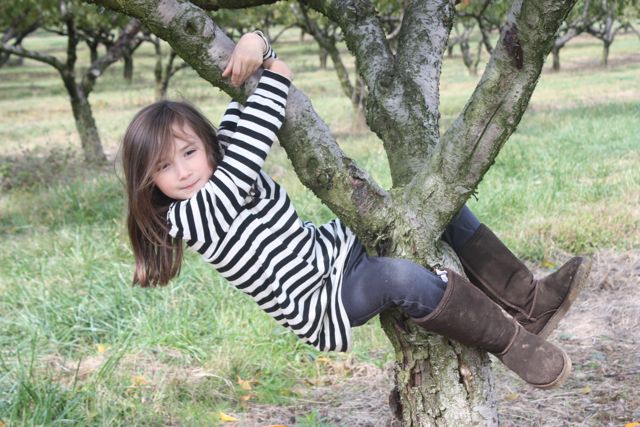
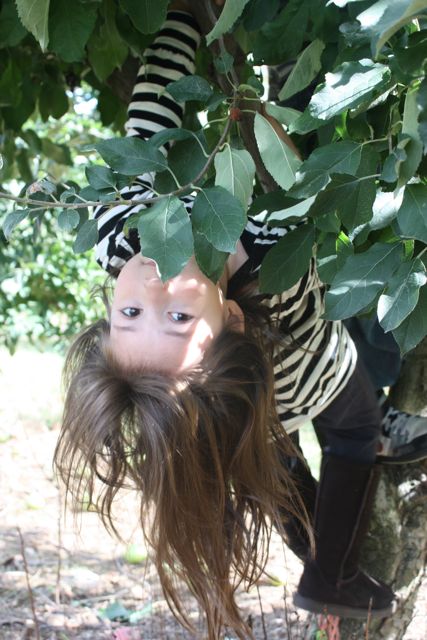
By contrast, a kid climbing a tree has no public “failure” if they decide they are not confident enough to reach the top; it’s not the same as freezing on a slide ladder and retreating. They can scale at their own pace and stop where they are comfortable doing so. If they get stuck (and I still, as an adult, often get stuck when climbing trees. Going up is easier than coming down), they are not faced with the sole option of a dead drop. They can search out footholds; they can ask for guidance. There is a very serious sense of accomplishment to navigating your way down a tree. It’s different every time.
There’s no end of physical challenges a kid can set up for himself in an open space. Jumping rock to rock. Walking only in the shadows. The rules are in their own mind, and they can make it more challenging as they like. With adult designed playgrounds, there are limitations. You go up the ladder. You go down the slide. It has a clear-cut purpose that is difficult to deviate from (assuming the adult supervisors allow it).
Green spaces foster community.
In a school environment, this community comes about by offering open-ended play, where the children work out activities as a group. In a neighborhood, it encourages members of the immediate area to spend more time outdoors, so that those who live around you are familiar faces. When you know the people in your shared space, you perceive it to be safer; and when parents believe it’s safe outside, kids spend less time in front of a screen. (Interestingly, this specific study links open spaces with water features to a decrease in screen time. Mere walkways, i.e. adult directed use of green space, doesn’t cut it.)
Green spaces are easier for parents to share with their children.
Let’s be honest: we know our kids want to spend shared time with us, and spending that time at a park is just a whole lot easier than spending time with them at a playground. In the same way that reading aloud to our kids generates a feeling of security and well-being that they can revisit for the rest of their lives as they read to themselves, and to their own children, spending quiet shared time in nature is an experience that kids can and will want to replicate. I can’t honestly say I love hiking, but I go hiking from time to time. Because that was something my father and I used to do, and I know it was something he found important, and it helps me to feel close to him now that he is gone.
Don’t underestimate the power of your company, and your priorities.
How is a kid going to lose weight just messing around outside? Wouldn’t a vigorous weekly hike be better?
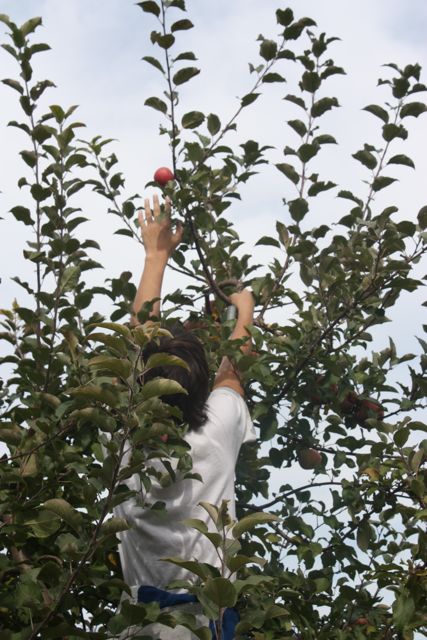
Nope. Getting a kid in the habit of being outdoors on a daily basis is building a healthy lifestyle. Plus, it’s been shown that three short bouts of exercise, 10 minutes at a time, can be just as effective as one half-hour effort. Getting up to move many times a day is also better for circulation and overall health; those who sit for four hours or more at a time (watching TV, playing video games, staring at a computer screen, or, one might worry, sitting at a school desk) are 125% more likely to suffer a cardiovascular event than those sitting for two-hour intervals.
Why am I telling you all of this?
It’s fundraiser time at my daughter’s school. It feels like it’s always fundraiser time at my daughter’s school. They’ll find ways to raise funds all year long, and then redo the blacktop around the playground. Or add a rock climbing wall. Wouldn’t it be less expensive to put a few big boulders and a pond back there? How about a vegetable garden? The kids could take care of the upkeep themselves, or parent volunteers. Hell, I’d be more than happy to donate $20 this month to sponsor an hour of garden work and a few packets of seeds. Way better than buying a magazine subscription I don’t want or need. Kids and parents could work together to benefit the school firsthand. While spending time together outdoors. I don’t know, it seems full of win to me. But I need more parents to agree with me before anything can change.
We currently live in a society that requires doctors to write a prescription for active outdoor time. It’s ridiculous. I suspect that anyone knows that outdoor time is good for your health and mind and soul. We know it in our bones. Why don’t we take the time to listen to our own bodies and instincts?
Ahhh, time. There’s the rub. And there, I have no practical advice or case studies to cite. I don’t know how to magic more hours out of the day or week. But we as good, conscientious parents need to figure out a way to make time. For the sake of our kids.
You are worried about seeing him spend his early years in doing nothing.
What! Is it nothing to be happy?
Nothing to skip, play, and run around all day long?
Never in his life will he be so busy again.
-Jean-Jacques Rousseau