Category: Green Home & Garden

  • Green Cleaning 101 (again!)

    Green Cleaning 101 (again!)

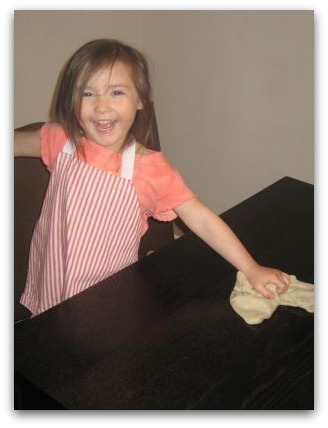
    child cleaning table

    This post contains recycled content. It originally ran on May 12th, soon after I started this blog, but in light of today’s video on DelawareMoms.com, I thought I’d republish it.

    Many thanks to Patti Petitte for getting me involved with this video! And for not making me seem too much like a goober.

    Cleaning your house with environmentally friendly household products saves you money, cuts down on clutter, makes your life much less complicated, and cuts down dramatically on chemical exposure. It is the epitome of simple, green, organic, happy living.

    I am not going to beat you over the head with statistics about the chemicals involved in household cleansers. I am only going to say that with lead paint on our toys, pollution in our air, traces of prescription drugs in our tapwater and residual pesticides in our clothing and linens, I am not going to use something to “clean” my house that is labelled Warning: Toxic. Keep out of the reach of children.

    To me, that says, Poison. Do not keep in house.

    Switching over to safer cleaning was easy. It made my life simpler and freed up a whole shelf in my linen closet. I can now delegate a fair portion of the cleaning to my children without fearing that they will sear their lungs or go blind. My husband enjoys the “mad scientist” element of mixing up his own cleansers. And you can customize the fragrances, strengths, and appearance to your liking.

    Here’s what we use:

    Dr. Bronner’s Magic Soaps. Vegetable-based and biodegradable, it is ultra-concentrated and will last forever.

    • Use it straight for: handwashing, clothing, dishes, bathing and shampooing of pets and humans ( remember that a little goes a long way!)
    • Add a teaspoon to a spray bottle filled with water for all-purpose cleaning: tabletops, counters, fingerprints on walls, spot treatment on carpets, everyday bathroom cleaning.
    • Use the tea tree or eucalyptus varieties for extra antiseptic qualities, or
    • Use the fragrance-free baby variety and add 20 drops of your own essential oils for scent.
    • In general, the longer you allow this to sit after spraying, the less “elbow grease” required.
    • These soaps do not foam up like you may be used to, which saves considerable amounts of time and water during rinsing.

    Dr. Bronner’s Sal Suds is an all-purpose cleanser that has that familiar scent of pine. It is specifically made for surface cleaning and is probably a better choice if you do not plan to use it as a hand or bath soap.

    • This is our floor cleaner, again using one teaspoon in a spray bottle filled with hot water.

    20 Mule Team Borax is excellent for heavy-duty bathroom cleaning.

    • Just pour some onto a sponge or rag and scrub away. It is non-abrasive and does not cause your hands to become red and swollen, like what I used to use.
    • Pour some into toilet bowl and let sit overnight, give a quick swish in the morning.
    • You can also add borax to your laundry to boost your detergent’s cleaning and whitening power.

    Vinegar and water in a spray bottle:

    • works as a general disinfectant (vinegar smell dissipates when dry, or add 20 drops of essential oil for scent and extra antiseptic qualities.)
    • is great for cutting through bacon grease residue on your stovetop.

    Club soda in a spray bottle:

    • Is a great mirror and window cleaner without the horrible fumes.
    • keeps stains from setting.

    Baking soda is known to soak up odors in the fridge. Also:

    • use instead of a Brillo to scrub pots and pans (if it’s really bad, pour baking soda on when pan is still hot and let sit throughout meal or overnight.)
    • sprinkle onto carpets and let sit overnight to absorb pet odors, vacuum in morning.
    • for kitchen sink drain maintenance, pour in some baking soda, then pour in vinegar for exciting foamy action; follow up with a kettle of boiling water.

    Lemon juice quickly gets the onion smell off your hands so you can rub your teary eyes. Or:

    • Freeze lemon juice in ice-cube trays and run through your garbage disposal to keep it sharp and smelling fresh. (Lemon peel and regular ice cubes also does the trick.)
    • Combine lemon juice and water in a bowl and microwave for a minute; allow to cool; wipe microwave clean.
    • One part lemon juice to two parts olive oil can be used as a natural wood cleaner.
    • Not a cleaning tip, but good to know: Dip cut apple slices into lemony water to keep them from browning in kids’ lunchboxes.

    Houseplants are an easy way help keep your air clean and fresh, and they just make you feel better about yourself.

    • I highly recommend an aloe plant in your bedroom, because they release extra oxygen at night, when you’re breathing deeply. After a full year of extreme negligence, ours is still alive, lush and enormous; and you can use the aloe as an emergency lotion or sunburn treatment.

    Spray bottles and a bucket to keep everything together can be found at your local dollar store. Dr. Bronner’s and essential oils are available online and can be found at health and organic stores; we get ours from Trader Joe’s.

    I cut old towels into rags in lieu of sponges, and wrap one around our old Swiffer for mopping.

    “Our house is clean enough to be healthy,
    and dirty enough to be happy.”

    -Anonymous

    Further reading:

    Organic Housekeeping by Ellen Sandbeck
    Clean House, Clean Planet by Karen Logan offers up cost analysis in addition to recipes
    How to Grow Fresh Air by B.C. Wolverton classifies 50 houseplants by how effectively they clean your air and by ease of upkeep.

    For a comprehensive list of essential oils and their properties, click here.

    This post was first in a three part series. You may also like:
    Green Cleaning 101: Family Edition, or
    Green Cleaning and Social Responsibility.

  • Dr. Bronner’s OK for HE Washing Machines!

    We got an Energy Starred, HE washing machine close to a year ago. According to the instruction manual, it is of vital importance that you use the correct laundry detergent in these things or else something dire will happen, and more importantly, you will void your warranty. So I dutifully gave away the dozen or so bottles of Purex I had stocked up (it was a GREAT sale) and started buying Sun & Earth Ultra Laundry Liquid.

    Now, Sun & Earth works great and smells even better, I highly recommend it if you can find it. BUT I’ve been buying Dr. Bronner’s by the gallon, and I try to multi-task it as much as possible, so that I have less plastic coming into the house.

    Now, Dr. Bronner’s lists a million uses for their products on their bottle, but nothing specific on front loading, HE washers. ( I’ve had these bottles for a looong time, though. For all I know, they’ve updated their packaging.)

    I was nervous about using Dr. Bronner’s in the HE machine without some reassurance, so I emailed the company, but I didn’t really expect anything to come of it.

    Lo and behold, a prompt reply:

    Hi Robin,

    Thanks for writing. Both the castile soap and the Sal Suds work well in HE washing machines. For the castile soap, use 1/8-1/3 c. per load, for SalSuds use 1 Tbsp. You can add 1/4 c. of baking soda for an extra boost. Please let me know if you have any further questions.

    Yippee!
    One more reason to love Dr. Bronner’s…customer service!

  • Green Cleaning 101: Social Responsibility

    Quick recap of the Green Cleaning series thus far:
    1. Chemicals are bad. Don’t bring them into your home.
    2. Children like to help and they should be helping to clean, every day, until a habit is formed.
    Today I want to talk about green cleaning on a global scale.

    In my post about encouraging kids to clean, I mentioned that bedroom cleaning is an everyday must, because if you allow kids to let it go for a week, they will become overwhelmed. Faced with the magnitude of the mess, they become paralyzed and unable to begin. And they will give up. You, as a parent, will come back to that room after an hour and it will look exactly the same, and your child will be holed up in the corner, drawing. Your lectures will fall on deaf ears, because the child has already decided that he cannot do this by himself. And really, he can’t.

    This is what has happened to our world. People have not done what they are capable of, to pick up after themselves. They became busy, or they found it inconvenient, or they stopped thinking about it, or they just stopped caring. And the mess has grown to the point where the magnitude is overwhelming, and people have given up. They have turned their back on the obvious and are busying themselves with pretty pictures.

    They say that there is no proof of global warming. They say that recycling is pointless because recycling trucks and plants pollute too. They say that they didn’t make this mess and it’s not their job to clean it up.

    That excuse doesn’t hold water in our house. I don’t care if it’s not fair that everyone has to pitch in and help clean up the aftermath of an afternoon of unbridled three-year-old origami. We all live in this house and we hold a shared responsibility to keep it clean.

    No one is going to tell me their mother taught them differently.

    Like I’ve said before, it all starts with you. You need to take those first baby steps, make a small decision like using non-toxic cleansers at home.

    This in turn allows your kids make a real contribution to the family by chipping in and doing what they are capable of, which boosts their self esteem. They feel that their actions have an impact on their immediate environment. They eventually form lifelong habits of picking up after themselves, and a general aversion to clutter and mess. It becomes natural, a part of their character.

    Soon they will be pointing out the litter on your street. And at the park. Maybe you, as a family, will do a little clean-up after going on a hike. Maybe you will start a community clean-up. Learn about your local watershed. Carry canvas grocery bags. Compost. Buy less and recycle more. Look for more and more ways to reduce your ecological impact, and increase your impact on others’ awareness.

    This is when it gets exciting. You start getting up on your soapbox. You get loud. You point out changes that could be made at local businesses. You write your congressmen. You send out petitions. You speak at the local school. You start a blog.

    Your enthusiasm is infectious. Other people, maybe, make small changes in their own lives. This ripples out to the people whose lives they touch.

    I know that some people will never care, and that sucks. They will find you annoying. They will attempt to attach their labels to you, like you are some beast on exhibit at the zoo, something deviant and possibly dangerous. They will dismiss you as a hippie, a treehugger, a bleeding heart, a granola girl, whatever.

    Thank them for it, because their labels mean they are taking notice. You have broken through to their consciousness, at least a little bit. Maybe you are making them think.

    (Here’s my bleeding heart.)

    It’s not enough to preach to the choir. We need to break out of our comfort zone, be willing to look like a zealot. We need to start reaching people that wouldn’t change their habits otherwise. Make them uncomfortable. Make them think.

    Maybe they make fun of you to other people. But, maybe those people are more sympathetic. Maybe they can more effectively build on the foundation you have set. The ripple effect is unstoppable and on your side.

    We may have already passed the tipping point, environmentally speaking. We can’t wait for lawmakers and nonprofit groups to help us along, tell us what to do. We can’t wait for other people to see the light. We need to act.

    “The man who travels alone can start today;
    but he who travels with another
    must wait until that other is ready.”
    -Henry David Thoreau

    We need to start today.

    • We need to do everything we are capable of in our own lives,
    • We need to do more than our fair share to compensate for those people who don’t care,
    • We need to talk about it but not complain about it,
    • We need to infect people with our enthusiasm,
    • We need to inspire others with our actions,
    • We need to lead by example.

    “You must be the change that you wish to see in the world.”
    -Mahatma Gandhi

    Now, I don’t feel that I am a leader or that I am inspiring, generally speaking. But I know that I am, to my kids. So I am starting there. Every kid, remember, wants to be helpful and useful; and every adult has one of those kids inside them.

    It’s not enough to just preach to the choir, either. We need to remind people that taking care of our earth, our shared home, is a social responsibility. We all live here and we have a shared obligation to keep it livable.

    We need to help them remember the lessons and values that their mothers taught them.

    And we need to do it today and every day. Until it becomes a habit. A part of our character.

    “Do something every day that you don’t want to do;
    this is the golden rule for acquiring the habit of doing your duty without pain.”

    -Mark Twain

    Further reading:

    Michael Pollan, author of In Defense of Food: An Eater’s Manifesto, wrote an article titled “Why Bother?” that covers many of the same points I have here, only with more credibility and eloquence, and less hands-on-hips lecturing;

    50 Ways to Help the Planet. Yes, another list. Is there anything else you can check off?