Category: Green Home & Garden

  • KinderCare Spring Camp: The Secret Science of Dirt

    KinderCare Spring Camp: The Secret Science of Dirt

    kindercare spring break camp

    Children are born true scientists.
    They spontaneously experiment and experience
    and reexperience again.

    They select, combine, and test,
    seeking to find order in their experiences—

    “which is the mostest? which is the leastest?”

    -R. Buckminster Fuller

    It seems impossible that spring break and Easter are only a few weeks off, what with a Nor’easter on its way and the SNOW word being bandied about, but the weatherman assures me that indeed it is coming.

    I’ve been in a state of mild panic about what to do with these kids during their break; Jeff works full-time, I work from home full-time. I can’t take them anywhere fun during the day, but I’m not about to let them sit in front of a screen all day (you know, like I do. Cue guilt). And while I’m cool with “just go outside, boredom is good for you” a few days a week, it seems like an unfair way to spend an entire vacation.

    Happily, while public schools are on break, local KinderCare Spring Camps are in session! We have lots of KinderCare centers in Northern Delaware. I’d always thought they were just for toddlers and preschoolers, but the camp has full-day programs for both preschool and school-aged children.

    And— this was the kicker for me— the theme this year? “The Secret Science of Dirt.”

    Did you know…

    • that some types of monkeys eat dirt?
    • that it can take hundreds or thousands of years to make just one inch of dirt or soil?
    • that soil or dirt can be of different shapes?
    • that one cup of soil may hold as many bacteria as there are people on Earth?
    • that the weight of all the bacteria in one acre of soil can equal the weight of one or two cows?

    I know, right? Dirt is fascinating! I can’t wait until I (I mean, the kids and I) get some free time and can stick some dirt samples from our yard under the microscope.

    Younger kids get five days of hands-on science lessons, veggie cooking, and craft-making, while the school-agers get five days of planting and tending vegetables, making compost, creating garden-related crafts, and preparing veggie treats. At the end of the week there’s a “Dig it! Science Fair” that parents are invited to attend (so stinkin’ cute).

    Looking ahead to summer, they’ve got 12 more themed weeks of educational fun available: Wilderness 101; Dig Ancient Egypt; Wild, Wild West; Scienterrific; Spectacular Sports; Animal Antics; Gross and Gooey Science; Kids’ Kitchen; Sports Smarts; Art Expo; Splish Splash! and Feats of Science.

    ————————————————————————————-
    When I was in high school, I was part of a traveling chemistry road show and performed some simple experiments for grade-school kids. Like any normal 16yo, I signed up for this because it got me out of school for an hour or two once a month, but I really really enjoyed it, because kids of that age eat that stuff up. At first it seems like magic, but when you break down the processes to whatever their comprehension level is (and folks, it’s higher than you think) you just see the dawn break, you can hear the click in their minds as it all slots into place. And then they’re racing to apply that new knowledge in as many other places as they can think of.

    It’s such an amazing and exciting thing to experience, and I’m so excited that Cass will get a chance to do some hands-on science in a fun environment, making new friends in the process. (Yes, I could do all these activities at home, but that’s not as cool, is it? I WISH. I’m hoping the third-party wow factor will make science experiment time with MOM more fun. Not that MOM isn’t willing to do them all by herself, because Mom is a total nerd like that.)

    Teaching should be such
    that what is offered is perceived as a valuable gift
    and not as a hard duty.


    -Albert Einstein

    Want all the dirt on KinderCare camps? All ya had to do was ask:

    KinderCare Spring Camp: The Secret Science of Dirt

    KinderCare Summer Camp: 12 week-long camps make kids the experts

    and while I’m thinking about it, you should totally check out the documentary Dirt! The Movie, which is available for streaming on Netflix. You’ll learn lots of cool facts about dirt and its importance, and the implications of the way we’ve been treating it. But you’ll also be amazed by the passion people have for the land beneath our feet.

    ——————————————————————————————–

    Disclosure time! KinderCare is sending Cassidy to a week of spring or summer camp (depends on availability). Although a review of that week is not required of me, you know I’ll be sharing all the details with you. Cass is excited!

    So, now what to do with the boys? Aged 10 and 13, any ideas?

    ——————————————————————————————-
  • Fashion Friday: Bring Back the Housecoat!

    Fashion Friday: Bring Back the Housecoat!

    house coat pattern

    “Think simple” as my old master used to say—

    meaning reduce the whole of its parts into the simplest terms,

    getting back to first principles.

    -Frank Lloyd Wright

    A few weeks ago I ran across this video for the koobli™: a “unisex cover-up garment designed to protect your clothing from life’s unpredictable spills and messes. Made from soft, supple, strong 100% micro polyester suede, koobli™ is lightweight and easy to slip on and pull off — use it to cover work outfits, suits, uniforms, gowns, etc. Tough enough for multiple wearings yet disposable when necessary, koobli™’s simple, sensible and functional design makes it a must-have for busy parents and caregivers.”

    Watch the video. I’ll wait. (RSS and email readers may have to click through.)

    Okeydoke. So, for the bargain price of $25 plus s&h, you too can have an adult smock.

    OR…..

    We could bring back the housecoat.

    I suspect if you were born after 1980, you may not even remember the housecoat. When I was searching for housecoats on Old Man Google, I found that most people used the term interchangeably with bathrobe, and the two are not quite the same.

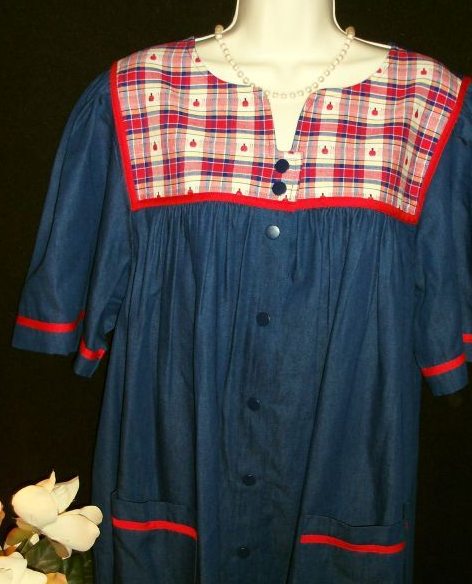
    Now, my Great-Aunt Jean had two types of clothing she called a housecoat. There were the “light housecoats,” which were handsewn cotton overshirts, with mother-of-pearl snap buttons and big poufy pockets with elastic at the top (so you could load them up with stuff but the pocket top would remain closed). You would wear these over your clothes when cleaning or cooking to protect whatever you were wearing underneath, and if the doorbell were to ring? The snap buttons pulled open in a, well, snap, and voila! You were presentable for company.

    This one is remarkably similar to the one that was “mine” when I went to visit and is for sale on ebay:

    light cotton housecoat

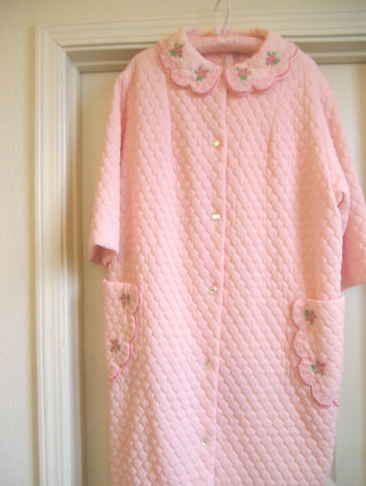
    The other housecoat, the “heavy housecoats,” were long and quilted and warm. They zippered all the way from the neck to the hem. Some were a thick sateen-like fabric, and some more a quilted flannel. They came in both short-sleeve and long-sleeve versions.

    Right up into very very old age, my Aunt Jean wore light fancy silky nightgowns to sleep in, and the housecoat to stay warm and presentable until she slipped into bed.

    Again, one on ebay that closely resembled “mine” when I went to visit. But no zipper.

    quilted housecoat

    These were hugely practical pieces of clothing. Why did they go out of style? I wasn’t there, but I have a couple of theories.

    The feminist movement.

    Aprons and housecoats, I suspect, were thrown off like shackles, symbols of the “perfect housewife” role that women no longer wished to be defined by. Aprons have come back as a sort of retro-cutesy ironic statement, but the utilitarian counterpart, the housecoat, still seems working class.

    The rise of disposable fashion.

    Once upon a time people made their clothes. Or they scrimped and saved to buy some nice things, and buying something new was sort of a big deal. (If you live in an older house, you totally know what I mean, because your closets are teeny-tiny.) You took care of your things. You mended them, you carefully washed and air-dryed them, and you protected them from dirt and grime so that you could get a couple of wears in before you washed again, prolonging the life of the fabric. Now? It’s no big thing if you get some sauce on your t-shirt. It’s so last season anyway, and it only cost five bucks at Target.

    Comfy pants.

    To put it simply, we don’t dress up to hang around the house or to sit down to dinner, or don a modest lacy thing nightly to sleep in (immodest, maybe, but not every night, and it’s not really for sleeping in, either). I love comfy pants as much as anyone, and in fact lived in them for pretty much 15 years straight. But now that I’m fully immersed in my Uniform Project, I’m gonna say… there’s something to be said for looking nice and put-together when you open the door for the UPS man, or the Jehovah’s Witnesses, or the elderly man who can’t find the park office, or your children (these all being people who have rung my doorbell this week).

    Cheap indoor heating.

    I grew up in a house where it was always freaking cold (unless it was unbearably hot). If you were cold, you put on a sweater and socks, or curled up under an afghan my mom had crocheted. In my great-aunt’s apartment, you put on your heavy housecoat. Today, people look at me like I’m insane when they hear we keep the thermostat to 63° daytime, 58° after 9pm. Heads up, people: dialing down the thermostat is green and it saves mad cash, and with oil prices the way they are you may want to get used to throwing on something long and warm over your regular clothes. (I am currently rocking a full-length flannel old man robe from L.L. Bean, and it’s awesome. But it’s belted. I’d love one that stayed zippered closed.)

    My modest proposal

    Here’s what I would like to see happen:

    • People buy less clothing, but pay more for items that are made sustainably, at a fair wage.
    • They relearn to appreciate styles that are practical and timeless and unlikely to become dated after a few months.
    • Because their clothing costs more, people take care of them. And learn to mend them.
    • Feminism becomes defined as equality and equal opportunity. Period. That includes the full ability to choose to be a homemaker, a SAHM, with no prejudice from male or female peers, dammitall.
    • People conserve energy. I think we’re probably headed this way anyway, but it bears mentioning. Everything is growing more expensive and we should all be socking away as much as possible. Turning down the thermostat and limiting the use of your dryer are two of the best & easiest ways to really put a dent in your power bill and keep $$ in your bank account. The benefits for the earth are a bonus.

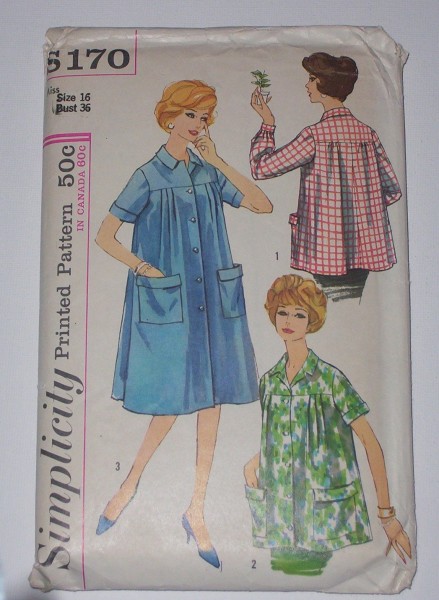
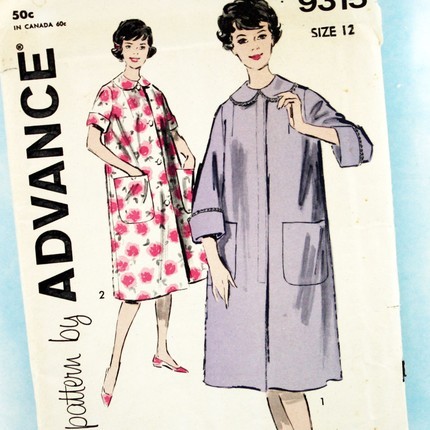
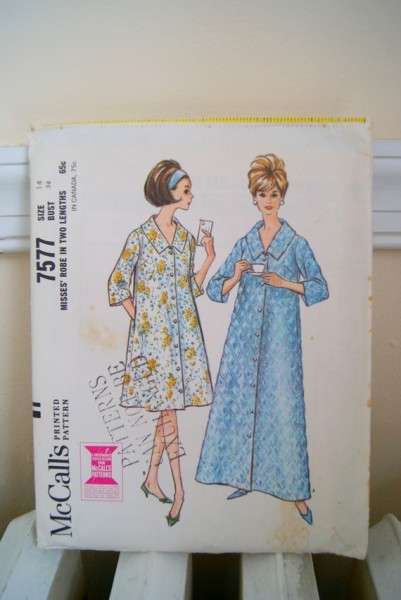
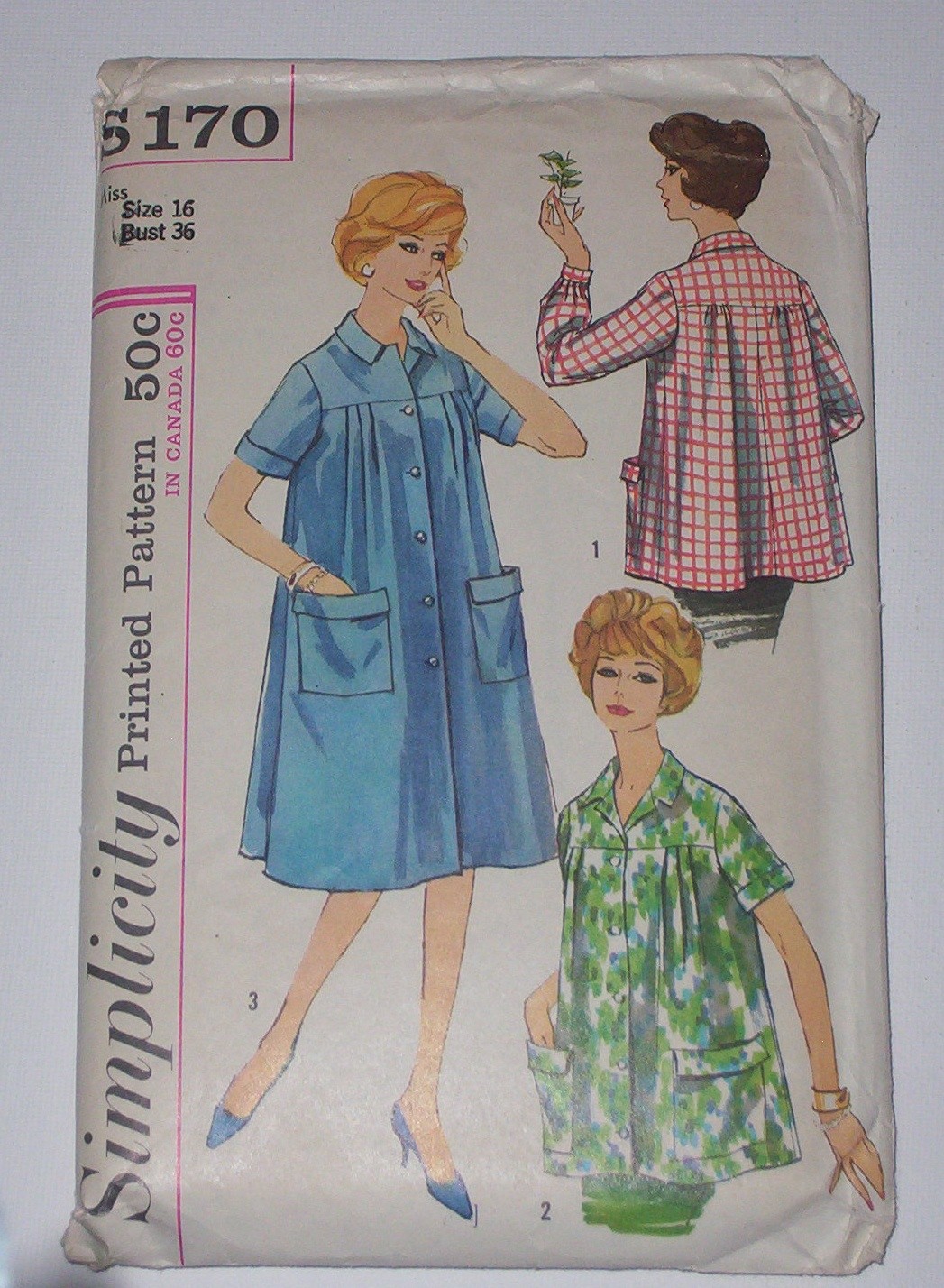
    If you’re handy with a sewing machine, I found a couple of vintage patterns on etsy… I bet you could find a market for these 🙂

    housecoat duster patterns

    $10 at lisaanne1960’s shop

    $5.75 at old2newmemories’ shop

    $3 at retrospex’s shop (in Philly!)

    Or, you know.

    You could totally go with a 100% micro polyester suede koobli™, tough enough for multiple wearings yet disposable when necessary.

    What do you think? Would you rock the housecoat?

    ———————————————————————————-

  • First Day of Spring, 2011

    First Day of Spring, 2011

    single yellow daffodil

    Spring has returned.

    The Earth is like a child that knows poems.

    -Rainer Maria Rilke

    Today is the vernal equinox, and at 7:21pm the moment we’ve all been waiting for arrives: winter turns to spring.

    And I am happy.