
Category: Conscious Consumerism: Shopping & Reviews

  • The 5 Best Toys for Creative, Active Outdoor Play

    The 5 Best Toys for Creative, Active Outdoor Play

    silly face

    It is a happy talent to know how to play.
    -Ralph Waldo Emerson

    As we drift from spring to summer I’m seeing a TON of (plastic, expensive) toys advertised for summer play.

    Maverick and I were talking about the best things to play with outdoors, and ultimately decided that the best toys are the ones that don’t come with instructions (for putting together or for playing with). We put together this list of five toys that kids of any age will find entertaining, and some suggestions for their play use, although kids won’t need ’em. They’re open-ended for physical and/or creative play, they’re highly portable, and they’re equally enjoyable for littles, not-so-littles and adults to play with together.

    The best part? You could conceivably buy every item on this list for a total cost of, I don’t know, 30 bucks at most. In my humble opinion, these 5 things assembled into a big box would be the bestest gift set for a kid’s birthday. Or a just-because gift for the kid-at-heart.


    The Only 5 Toys Any Kid Really Needs
    (some minor cheating involved)


    1. A Ball to Kick & Throw

    I recommend the kickball: you know, those rubber playground balls. They make THE most satisfying thwap sound when you kick or catch them. Play traditional kickball, dodgeball, wallball, soccer, basketball (keep in mind that a goal or a net can easily be approximated with pails, baskets, or just chalk-drawn lines. There is NO need to buy those for at-home use).


    The tennis ball is another option. If you’re lucky enough to have a dog that will fetch for you, we’re talking hours of easy entertainment. When I was a kid, I would happily toss a tennis ball against the side of the house for forever, catching after the first bounce (and I’m glorying in the memory of the sound as I type this: boom, bounce, catch. Boom, bounce, catch). A tennis ball is probably also a better idea for a toddler just starting to throw and catch. And, of course, you can pull together a makeshift round of baseball, golf, croquet or tennis using some sticks or branches (or in the case of croquet, flamingos).

    Ball play doesn’t just keep children moving; it builds mind-body coordination and naturally lends to understanding of simple physics and geometry. Introduce a ball to a group of kids with nothing else to do and you’ll see creative teamwork and active communication as they decide on a game and flesh out what the rules are; social skill-building as they challenge and debate what’s “out” and what’s fair.

    2. A Rope to Jump

    Honestly, I recommend two, for double-dutch or just so you can jump along with your child. Jumping rope is AWESOME cardio and the impact helps build bone density. It also makes kids more body aware and coordinated, which will help out in any other sport or athletic endeavor. The imaginative possibilities for a length of rope are great: a jump rope can be put to use as a tightrope or lion-tamer’s whip, as Tarzan’s primary mode of transport, for designating goals for ball play or “safe” zones for tag, for tying bad guys to tree trunks.

    The rope pictured is an eco-model, 100% U.S.-made cotton rope (7 feet long and adjustable) and 100% recycled plastic handles. For a refresher on the rhymes we used to chant on the schoolyard (which build memorization, rhythm and speech skills!), try Anna Banana: 101 Jump Rope Rhymes; prices on used copies start at a penny.


    3. A Flying Saucer

    The frisbee is probably my favorite toy. As it is subject to the whims of any winds passing by it’s an equal-opportunity for cardio (meaning that no matter how talented you are at flinging and jumping, you’re probably still going to have to run after the thing). I could pass a frisbee back and forth for a good long time before I got bored, but frisbee baseball or frisbee golf are great semi-organized games for kids of all ages to play together— the relative skill set is pretty much irrelevant. In terms of imaginative play, the frisbee doubles as home plate, a dinner plate or a hat to balance on your head 🙂

    The frisbee pictured is an “EcoSaucer” made from recycled milk containers & grocery bags, and the packaging is recyclable. We have this one and I think it cost us five bucks.


    4. Tarp/Length of Fabric

    Even an old sheet would do, but I would spring for something like this one, which is lightweight, water-resistant and folds into its own case with handles. (Also comes in a bunch of colors.) It’s a tent, a picnic blanket, a cape, a tablecloth, a cloak of invisibility, a wedding veil, a set of wings, a parachute, a raft… you get the idea. The sky’s the limit as long as it’s theirs and they don’t have to worry about getting it dirty or messing it up.

    5. A Deck of Cards

    Sometimes, a kid’s gotta rest. Sometimes it rains. You can play cards by yourself or with friend(s); you can play a game you both know, or teach/learn a new game, or make one up. The really talented can build a house of cards (I do not fall into that category, but my husband does).

    We jump to the notion that cards are boring, but I think I’m probably not alone when I say I have very specific childhood memories attached to the tactile feel of a playing card, and to the sound of a sharp shuffle. In any case, we have a lot of possible educational benefits here: memorization, development of small motor skills, basic math concepts & patterns, quick decision making, anticipatory decision making, statistics, not to mention the opportunities to learn to read body language, to focus, and to just plain sit still for periods of time.

    The set pictured is an eco-edition printed on sustainable forest papers, with starch-based laminating and vegetable-based inks. Both deck and case are fully recyclable. It sells for about four bucks.

    BONUS: Don’t forget about the big box.

    No, I’m not kidding. I think this would make a great gift set for ANYONE, but especially kids of a certain age if packaged in a big ol’ box. Go to an appliance store and ask for something massive. Seriously. Think how much fun that kid will have in his clubhouse/ spaceship/ cave/ castle/ secret hideout/ whatever (and then it can be folded and used as a sled on a grassy slope).

    _____________________________________________________

    In play a child always behaves beyond his average age, above his daily behavior.

    In play it is as though he were a head taller than himself.

    -Lev Vygotsky (Russian psychologist)

    Children learn by playing, and what they learn most is who they are and what they are capable of. We do them a disservice when we provide them with toys that are too solitary, too narrow in purpose, or too complicated. Or even with just too many. Keep it simple and open-ended, add plenty of free time and room to roam, and join in when you can… recapture some of those joys of childhood for yourself, and let your kids teach you a new game while you’re at it. Get out in the sunshine and play!

    _____________________________________________________
     

    Now, there were some serious contenders that didn’t make the final cut (for instance, a bike, since it’s not technically something you “play” with), so maybe I’ll write those up as a “booster pack” sort of post.

    But first I’ll ask you: what toys would you include in your “Top Five Must-Have Toys of Childhood?

    ________________________________________________________

     

  • I like to ride my bicycle… I like to ride my bike…

    I like to ride my bicycle… I like to ride my bike…

    cass-training-wheels

    Nothing compares to the simple pleasure of a bike ride.

    -JFK

    My kids have all been riding on bikes that are woefully small for them. I don’t know when all this growing keeps taking place, but I wish they’d cut it out, it’s expensive.

    Maverick graduated to Jake’s hand-me-down bike, and I’m going to have to get Jake a new one soon; for now he’s content with the skateboard and quick turns on the outgrown bike.

    Cass needed something new, so we drove over to Toys R Us. It seemed like a logical place to get a kid’s bicycle.

    Sigh. Honestly, I don’t know what I was thinking.

    FIRST of all, there are two walls of bikes. Want to guess how they’re divided?

    Not little bikes and big bikes.

    Boy bikes and girl bikes.

    The choice obvious, unarguable, Cass trotted over to the girls’ bikes. We had already discussed the fact that I would not be buying a Disney Princess bike or a Dora the Explorer bike, but I was really unprepared for the bubble gum explosion.

    Every bike on that wall was hot pink or metallic purple and had names like:

    • Ride with Me Barbie 16 inch Girls BMX Bike
    • Hot 18 inch Girls BMX Bike (hot pink)
    • Pinkalicious Bike
    • Wild Child Bike (light blue & hot pink)
    • Disney Fairies
    • Waikiki
    • Coral Mist
    • Flower Power
    • Pixie
    • Rosebud
    • Puppy Love
    • Skelanimals
    • Bubble Pop

    Even the brands I had high hopes for (Mongoose, John Deere for christsakes, and Tony Hawk) were HOT PINK.

    So I had to decide, was it better to choose a bike that was less overtly girly-girl, or to buy a Tony Hawk bike that’s hot pink? WHY IS TONY HAWK MAKING HOT PINK BIKES?!

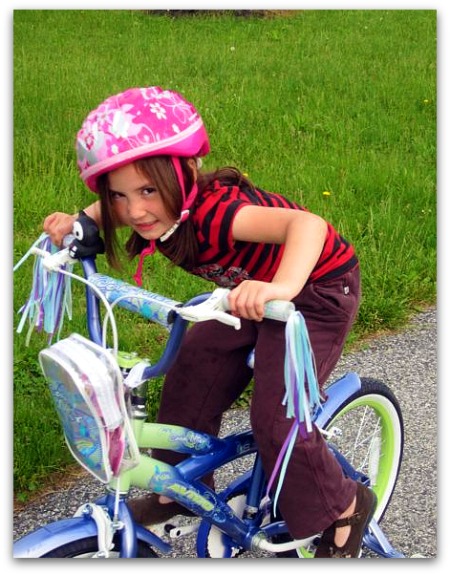
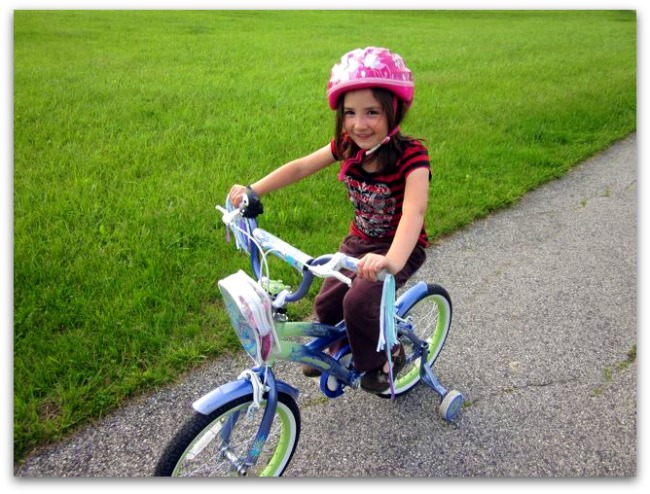
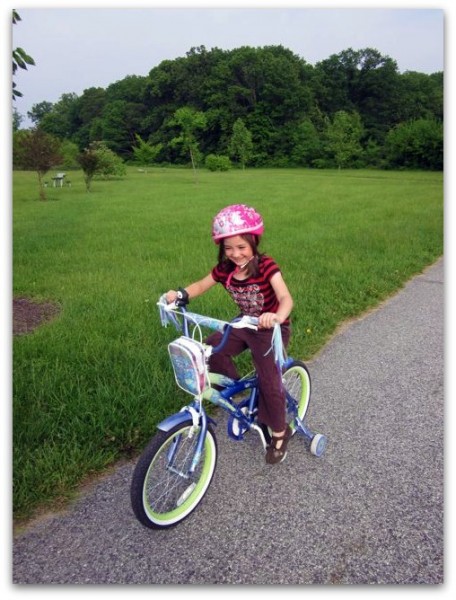
    We went with Coral Mist, which is purple & green. Cass tries to look tough on it, but it’s sorta hard. Especially when all the helmets were (you guessed it!) pink.

    cass-tough-bike

    After waiting an interminable amount of time for someone to come help us— i.e., actually grab the bike and pull it down so she could testdrive the thing— we gave up and just pulled the ticket to give the cashier. And then, when I went to checkout, I was given the option of buying a ONE YEAR warranty. That didn’t cover tires. For real? What kind of POS was I buying here?

    ______________________________________________________
    Look. I realize people think I’m making a big deal of nothing, but I found the whole experience supremely irritating. Why do we have to have gender-specific bicycles? Boys and girls use them in exactly the same way, and for this age group they have the same metal frames, more or less.

    (UPDATE: Jeff is informing me that girl bikes are built so that you can ride them wearing a skirt, which is the most inane horse puckey I have ever heard. NO ONE should be riding a bike with a skirt. That is basically saying, girl bikes are built so you can sort of ride them but not really. LOVE that we are continuing to manufacture bicycles according to archaic sexist societal norms. AWESOME.)

    (FURTHER UPDATE: Now he is telling me that boys’ bikes are stronger and intended for jumps and tough riding.)

    (He has stopped talking now as he becomes aware he’s pissing me off. And that I’m typing what he says.)

    (He says girls like princesses and petunias. Girls like pretty bikes, and boys like cool bikes. It’s genetics. ZOMG, help me please.)

    ____________________________________________________________

    I should have checked online first. Then I would have seen this:

    Those are your choices.

    Boys. Girls. Women.

    Not Men. You know why? MEN DON’T BUY BIKES AT TOYS R US. Men buy real bikes, heavy-duty modes of transportation and extreme sport. Not toys.

    But yes, Toys R Us carries women’s bikes. A  woman’s bike still qualifies as a toy.

    I freaking hate Toys R Us.

    ___________________________________________________
    Anyway, I’ve been taking the kids to the park to ride; I walk alongside Cass as she wheels down the path. She’s still shaky, and we move at a brisk walking pace at best. If she starts to move faster, she hits the brakes and I bite my tongue.

    Right now we’re just building up her leg muscles and her confidence; I don’t want her to get too dependent on the training wheels. But I can’t wait until she has the confidence to fly. It’s difficult to conjure up a more exhilarating feeling.

    In fact, seeing her on that bike has me yearning for my own. I’m thinking of signing Jake and me up for the Delaware Bike to the Bay. I did it when I was like 9 years old, so I feel like I should be able to train in time for the late September ride. In any case, you can choose routes that run 17, 45, 75, or 100 miles, so I can always upgrade or downgrade as necessary.

    But first Jake and I need bikes. And helmets.

    And we’re sure as hell not getting them from Toys R Us.

    _____________________________________________________

    Are you an adult bike rider? What make is your bike?

    girl-bike-park

  • Why We Need Modern Day Victory Gardens

    Why We Need Modern Day Victory Gardens

    I am of the opinion that my life belongs to the whole community
    and as long as I live,
    it is my privilege to do for it whatever I can.

    I want to be thoroughly used up when I die,
    for the harder I work the more I live.

    -George Bernard Shaw

    The boys and men of Europe marched to war in the summer of 1914. As a by-product of the fighting, fields of crops were crossed, slashed, burned, rendered useless. This set into motion a food production imbalance that proved catastrophic in 1916, as crops failed everywhere. Rations were set into place; all of Europe submitted to meatless days and dairy could only be had with a physician’s explicit prescription. Italians were allowed only nine pounds of sugar a year, and that only if sugar was to be had.

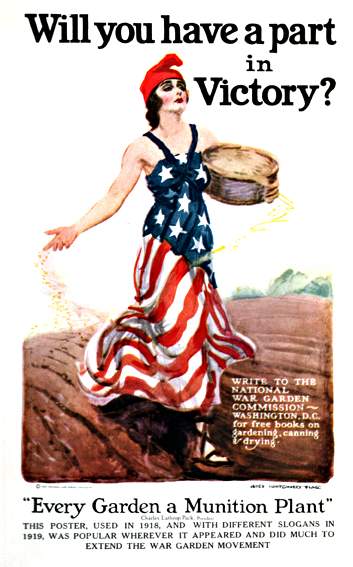
    It was up to us here in the United States to feed the world’s starving and we rose to the challenge. In 1917 Charles Lathrop Pack organized the National War Garden Commission and brilliantly marketed the war garden campaign: selling the victory garden as an act of patriotism, of freedom, of independence and the American Way.

    To waste food was to fail our troops and aid the enemy, it was as simple as that.


    “…every one who creates or cultivates a garden helps and helps greatly, to solve the problem of the feeding of the nations – and that every housewife who practices strict economy puts herself in the ranks of those who serve the nation.  This is the time for America to correct her unpardonable fault of wastefulness and extravagance.

    Let every man and every woman assume the duty of careful, provident use and expenditure as a public duty, as a dictate of patriotism which no one can now expect ever to be excused or forgiven for ignoring.”

    -Woodrow Wilson, in a proclamation to the American people,
    nine days after U.S. declaration of war


    When all was said and done, according to U.S. Department of Agriculture estimates, the Greatest Generation planted more than 20 million victory gardens: producing up to 40% of the vegetable produce consumed nationally in their own backyards, conserving food and funds that could be diverted to our troops in the pursuit of victory.

    Victory gardens have enjoyed a slight renaissance these past few years; First Lady Michelle Obama has emulated Eleanor Roosevelt in instituting a victory garden on White House grounds. Urban homesteaders and locavores cultivate gardens to free themselves from Big Ag and oil dependence.

    It’s not enough.

    Nationally gas prices are up 38% over last year. The average driver will wind up spending $1000 more on gasoline, forcing many to shift money from their grocery budget.

    The uptick in gasoline prices hits us again in the form of increased food prices.

    Globally, we waste over a billion tons of food a year, or a third of all food produced; $54 billion worth of food is thrown away annually in this country. 98% of that ends up in landfills, not compost piles, wasting more gasoline in transport and contributing to global warming.

    Yet 68% of Americans are overweight or obese.

    Meanwhile, in 2009 (and presumably more since then), 50.2 million Americans lived in food insecure households; about a third of those are children. 14% of Americans are on food stamps, an increase of more than 58% over 2007.

    Nearly half of those considered food insecure don’t actually receive food stamps or other government nutrition-assistance programs.

    And healthcare costs per family have more than doubled over the past decade.

    Do we really need to suffer a war-induced food crisis before we are compelled to step up?

    As a generation that, for the most part, has lost its sense of civic duty, agricultural skills and connection to the earth and the seasons, would we be capable of answering that call if it were issued? Are we made of tougher stuff?

    We need to relearn those skills, to be able to live in a self-sufficient way, to be able to provide for our countrymen should the need arise.

    —————————————————————————————————————————————

    But I’m saying the need is already here, and many are fighting a great war at this moment. Just to feed their children decent food.

    • Try your hand at gardening this year. No need for great expectations; as Emerson said, “Do not be too timid and squeamish about your actions. All life is an experiment.” We learn by doing.
    • If you have gardened before, experiment with new crops; see just how much your victory garden can yield.
    • Don’t waste food.

    “Those who cultivated the soil could hardly do more than they were doing,” said Luther Burbank, a member of the National War Garden Commission, in speaking of the matter. “It was becoming evident that food, which before had been taken as a matter of course, was in reality the foundation of all life, all knowledge, all progress. What could be done? It became necessary to conserve carefully what already had been produced, and then produce more. Agriculture and horticulture had not generally been taught in the schools; the old hit-or-miss plan of farming was all too common’ the home garden was neglected and the school garden a novelty. To the call both to conservation and to increased production, the American people have responded nobly. How quickly they have changed their attitude, how splendidly they have made good by adapting themselves to the new conditions! When the war garden movement was started, the problem of food production was on the way to be solved.”

    Be honest with yourself.
    Are you part of the solution? Or the problem?

    ________________________________________________________________________

    Content & Photo Sources:

    Wikipedia: Victory Garden

    Small Homestead: History of the Victory Garden

    “Do Your Bit For America”, Woodrow Wilson proclamation 15 April 1917

    The War Garden Victorious: its war time need and its economic value in peace, by Charles Lathrop Pack. This is available in its entirety online and hugely fascinating. I would have simply titled this post READ THIS with a link, if I thought people would actually do it.