Category: Conscious Consumerism: Shopping & Reviews

  • CLOSED: Conscious Consumerism: Marcal Small Steps (plus giveaway!)

    CLOSED: Conscious Consumerism: Marcal Small Steps (plus giveaway!)

    marcal small steps

    Any fool can destroy trees.
    They cannot defend themselves or run away.

    And few destroyers of trees ever plant any;

    nor can planting avail much
    toward restoring our grand aboriginal giants.”

    -John Muir

    98% of purchased paper products come from trees.

    Ninety. Eight. Percent.

    2% of purchased paper comes from recycled content.

    Only. Two. Percent.

    What I want to do here is rant about how people feel entitled to wipe their bums, blow their noses, clean their chins and countertops, and print their LOL email forwards on paper that sacrifices trees that take decades, centuries to grow. That are bleached to the whitest white and marketed as being luxurious, or fluffy like clouds. Why? Why? Do we really need to wipe our bums with fluffy clouds? Really? Really?

    But I’m behaving myself today. Let’s skip the rant and instead recap why trees are important, shall we?

    • Trees absorb carbon from the atmosphere (greenhouse gases)
    • Trees’ dark green leaves absorb light from the sun (retaining heat during the day and slowly releasing)
    • Trees take up water from the soil, which then evaporates into the atmosphere (creating heat-deflecting clouds, another global-warming deterrent)
    • Tree root systems prevent erosion & loss of fertility (soil conservation)
    • 70% of the earth’s animals & plants live in forests. Most will not survive clear-cutting.

    Since not all our paper is sourced from rainforest, I WON’T EVEN MENTION that tropical rainforests house half the world’s varieties of plants, many of them medicinal (two-thirds of cancer-fighting agents originate in rainforest), in a land area that’s only 7% of the world’s land mass. And that we continue to discover new species there all the time.

    Oh. Well, maybe I will. IT’S IMPORTANT, YA’LL.

    One of the easiest ways we can help the earth out is by mindfully consuming paper.

    As in, don’t use paper if you don’t need to.

    • Save files on your computer rather than print them out.
    • Read books on an e-reader rather than buy hard copies (you can download the Kindle app to your computer for free and read on your Mac or PC)
    • Subscribe to digital versions of magazines or newspapers
    • Pay bills online; opt out of junk mail; get off catalog mailing lists
    • Switch to rags for cleaning, cloth napkins for mealtime, handkerchiefs for noses
    • Write your to-do & grocery  lists on a digital calendar; bonus points if you sync to your phone.
    • Draw on chalkboards or whiteboards and snap a pic for posterity.
    • Encourage art projects that use recycled materials.

    When you do use paper, for the love of Mike please reuse the blank sides. If you need coffee filters buy the unbleached ones, and compost them. If you buy a Sunday paper for the coupons, shred the paper for the guinea pig cage. Save the envelopes that come in your junk mail for when you have to send a check or money into the classroom. Be creative.

    Recycle all you can.

    And then, complete the cycle. Retailers are not going to shift the new:recycled ratio until there is a quantifiable demand for recycled content products.

    When you buy paper products, buy recycled.

    Let companies know where your priorities are, and how you want to spend your dollar. They will pay attention.

    We switched over to cloth napkins, hankies and rags a long time ago, but I still need to buy the occasional box of tissues for a bad cold. I also buy paper towels for draining bacon and cleaning up puke (it’s necessary; we’re talking two, three boxes and rolls a year). And, we do use toilet paper, a state of affairs I don’t see changing anytime soon.

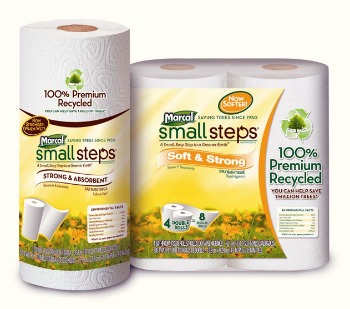
    We’ve always used Marcal, for the simple reason that it was inexpensive and the Sunday paper runs coupons for their products all the time. When we first officially “done gone green” back in 2008, I was beyond pleased (and mayhaps a little smug) to find out that not only was Marcal frugal, but comes from recycled content too.

    • Marcal Small Steps is made from 100% recycled content paper (30% post-consumer, meaning a consumer has used it & recycled it.)
      • For comparison’s sake: Seventh Generation is also 100% recycled content, and an impressive 90% post-consumer. It’s also a bit more expensive than I think every other brand out there.
      • Scott Naturals is 40/40.
    • Marcal processes 200,000+ tons of recyclable paper—magazines, office & school paper, flyers, junk mail & printers’ waste (printer’s waste being an example of recycled content that is not post-consumer, like the ends of paper rolls)— every year, thus saving over 4 million trees and producing more than 12 million cases of paper products annually.
    • Air-fluffed TP (anything vaguely resembling clouds, or quilts, or angel’s wings) is an energy-intensive process, considerably more so than the traditional process Marcal uses. That’s totally not even thinking about the energy expended clear-cutting forests. BUT YOU SHOULD THINK ABOUT IT BECAUSE IT’S IMPORTANT.
    • AND, soft and fluffy is no good for your plumbing and sewer systems. The thinner stuff is designed to be blown apart upon flush impact. Soft and fluffy? Turns into a thick, gloppy mess that clogs easily and is no fun to watch your plumber husband extract from pipes. You’d think it would be, but it’s not.

    But the best part is, Marcal recently updated their look and product line (by recently, I mean I have no idea exactly when this happened) and the toilet paper is softer, the paper towels are now durable. So it’s not even like you’re making some sort of sacrifice to use the recycled product. It is every bit as practical, and frugal too. No excuses!

    Wanna try it out?

    The nice folks over at Marcal are offering one of my readers a sample pack of Marcal products (toilet paper, tissues, napkins, and paper towels).

    Just leave me a comment letting me know one thing you do to cut down on your paper consumption for your chance to win.

    Bonus entry: “Like” my Facebook fan page and leave a 2nd comment telling me you did (or that you already were a fan).

    I’ll pick a winner next Saturday morning before soccer, 4/30/11.

    Don’t forget, you can check your Sunday paper for coupons, they’re in there all the time. Or, “like” Marcal’s fan page for an instant-gratification printable coupon.

    Find stores that carry the Marcal brand here.

    ——————————————————————–
    Full Disclosure: I happily accepted an offer of a trial roll of Marcal paper towels and a package of TP for review purposes. No other compensation was received for this post.

    ——————————————————————–

    AND THE WINNER IS:


    Comment #2, Aimee! Thanks to everyone who entered!
  • Review: Home-Ec 101, Skills for Everyday Living by Heather Solos

    Review: Home-Ec 101, Skills for Everyday Living by Heather Solos

    home ec 101

    A human being should be able to change a diaper, plan an invasion, butcher a hog, conn a ship, design a building, write a sonnet, balance accounts, build a wall, set a bone, comfort the dying, take orders, give orders, cooperate, act alone, solve equations, analyze a new problem, pitch manure, program a computer, cook a tasty meal, fight efficiently, die gallantly.

    Specialization is for insects.

    -Robert A. Heinlein

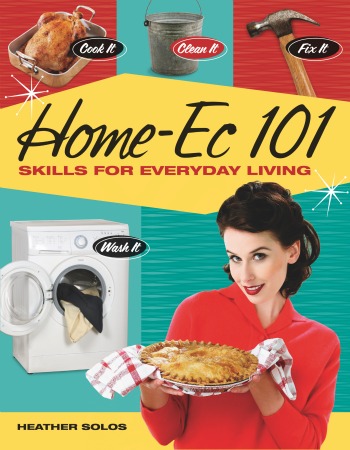
    OK, so Home Ec 101: Skills for Everyday Living doesn’t teach you how to do ALL of that, but it comes pretty darn close, and this was the quote dancing through my head as I read through it.

    Those who know me have heard me go off, at beautiful length, about how I think all high schoolers should have to take a Home Ec course that goes beyond how to sew a skirt and roast a chicken. (I also think they should require a basic course in car maintenance, FYI. All women should know how to change a tire.) Teens should learn how to do the practical, everyday things that we really need to do as adults with households to upkeep: how to fix a running toilet, how to remove wallpaper, how to diagnose what’s ailing your dishwasher, how to get the dog pee smell out of your couch. Heather Solos addresses all these issues in her awesomely retro Home-Ec-in-a-Book, and does it with a style and verve that makes for an enjoyable read as you’re being totally schooled.

    Now, I knew I was going to love this when I came across a passage early on in the book discussing what to consider when choosing cleaning products, and Heather footnotes:

    The three Rs of environmentalism are Reduce, Reuse, Recycle, not Run-Out-and-Buy-New-Crap.

    YES. Sing it, sister.

    The book is divided into four major sections: Clean It, Wash It, Fix It, Cook It, with a handy-dandy appendix for reference and (double YES) an index. It drives me batty when info-heavy works like this don’t provide an index.

    Clean It

    For someone that isn’t writing from a strictly green perspective, Heather is surprisingly eco-minded. I love that she touts green methods like vinegar and water for the toilet simply for being practical and effective. (Triple YES.) I also love how she doesn’t encourage super-sterilization; often these sorts of titles cater to germaphobes. Nope, Heather Solos says,

    Back to wiping, next up is the rim. Any cleaner that has splashed up from the bowl will make this job easier. Remember, it’s just cleaner and water from the bowl, not actual body fluids, don’t be a baby; hands wash.

    That’s just awesome.

    Heather explains what different cleaners are and how they work, which I thought was crazy useful. She gives pointers for delegating household chores. She addresses real-world questions like how to clean diarrhea from a carpet (dude, it happens), how to properly clean pillows and how to care for a butcher’s block table (this was something I’ve wondered about). I have read a lot of cleaning books doing research and this one is really fantastically thorough.

    Wash It

    Extend the life of your clothing! This section includes a table of common and not-so-common stains and how to remove them, deciphers care instructions, gives tips on repairing and altering your clothing, offers advice for conquering the laundry mountain, and answers questions like, “Does an extra dirty load of laundry require extra detergent?” A veritable treasure trove of little-things-I-wish-I-knew-offhand-but-don’t.

    Fix It

    Well, in this department I have a confession to make. On our first date my now-husband unclogged a shower drain that my roommates and I had been battling unsuccessfully for days, and that was when I knew he was a keeper. (We were 19. At 19, the ability to take apart plumbing is like magic.)

    So, I don’t fix things. Jeff does. But if you don’t have a Jeff, you might find this section detailing vital tools to keep in your toolbox, troubleshooting a troublesome washing machine, vacuum maintenance, leaky toilet seals, picture hanging, fixing small holes in your walls, and yes, unclogging drains, to be useful. It’s not comprehensive by any means, but hey, this is Home Ec 101. Check out your local Home Depot for more in-depth titles.

    Cook It

    When did cooking become a lost art? It’s a shame. I find that a lot of people buy cookbooks about comfort foods or French foods or whatever, and they’re doomed from the start: the recipe will ask you to braise something and you’re like, huh. What’s braising? Confidence shot, you make chicken fingers again. (I’m not speaking from personal experience or anything.)

    This section starts with the basics: terms, necessary equipment, techniques, pantry staples, and my favorite, the answer to the question “How do I get everything done at the same time?” It then moves into meal planning, substitutions, and recipes. (The Home-Ec 101 website has TONS of recipes. It also offers cleaning schedule reminders, sort of like the FlyLady but without! all! the unnecessary! enthusiasm and punctuation!) Quadruple YES.

    ——————————————————————-

    Specialization is for insects, folks. We should always aim to learn to do those things that will put us on a path to self-sufficiency, if not for the simple reason that it’s nice to feel capable, then for the cost-effectiveness of the thing.

    Think of how many times you’ve hired a plumber for something you’re pretty sure you could do yourself, if you only knew how. Think how many take-out meals you’ve eaten because you’re tired of the meals in your repertoire or because your grocery-shopping trip didn’t stretch you through the week. Think of all things you’ve thrown out because you figured it was irreparably stained or because the zipper was broken. This book can help you become a jack-of-all-trades and quasi-master-of-some. That’s a good deal in 200-some-odd pages.

    Home-Ec 101: Skills for Everyday Living is available on Amazon for a mere 13 bucks or so. I whole-heartedly recommend it, it’s fantastico and Heather’s sense of humor is adorable. Gift it for your favorite graduate! Tell ’em how much money you’ve saved them in the long run. They’ll thank you when the dog pees on the couch.

    ————————————————————————

    Disclosure time! I was provided a digital copy of Home-Ec 101 from the One2One Network for the purpose of review. It was in PDF form and I could not get it onto my Kindle to save my life, if anyone can help me please let me know.

    I received no compensation for this post, and as always all long-winded opinions are mine alone.

    ————————————————————————

  • On Staph and Grocery Store Meat, and the Price We Pay for “Fecal Soup”

    On Staph and Grocery Store Meat, and the Price We Pay for “Fecal Soup”

    flapping-hen
    Yes, I'm squawking again.


    There was an article on the USA Today site the other day, “breaking” the news that half of supermarket meat may have the staph bug (staph is bacteria that can cause a multitude of diseases and infections). Half of the contaminated meats held bugs resistant to at least three forms of antibiotics. They don’t spell it out, but the fear here is MRSA. Full disclosure, my uncle recently died of a MRSA infection, so I do believe MRSA is something worth fearing.

    This broad contamination of meat barely qualified as “news” to me. Meat producers know their meat is tainted, and that’s why it’s so emphasized that you need to cook your foods completely.

    I think most people know, on some deep dark guilty level, that factory farm conditions for animals are at best unethical and at worst criminally immoral. They are packed into stalls so tight they can’t move or lie down. They are forced to live in their own excrement. They are not properly treated for illness or any injuries they incur; instead, they are preemptively given antibiotics, which is how we get superbugs like MRSA. They are in a state of continual stress; they may never see daylight, or they may be under artificial lighting 24/7.

    Then they are corralled into slaughterhouses and treated in ways I can’t really talk about without wanting to vomit and go on some sort of vigilante rampage.

    We know all that, and we buy the meat anyway, which is a larger issue than I want to get into right now.

    Now for some stuff you might not know.

    Talking about our large livestock first: Big Ag has bought out or choked out of business nearly all small independent slaughterhouses, so even if you’re paying a premium for happy pigs and cows they are likely being killed using questionable practices, and cross-contaminated with whatever bugs came in with everybody else’s stock.

    Over 300 cows are hurled down the non-stop disassembly line every hour. The USDA inspector is the one man responsible for catching abnormalities and signs of disease in these carcasses as they slide by; he is also supposed to be checking whether the animal shows any signs of illness before being knocked unconscious (Mad Cow, anyone?). He is the only person legally regulating whether the kill is humane.

    At a rate of five per minute, my guess would be that he does none of these things well.

    Of course, we can’t know that. No cameras or guests are allowed on the slaughterhouse floor. And agribusiness is trying to push legislation that would punish people who take these jobs for the purpose of exposing cruelty and illegal practices.

    There is no transparency, no accountability.

    • 89% of US beef patties are estimated to contain traces of the deadly E. coli strain.
    • 70% of US pigs have pneumonia at time of slaughter.
    • Antibiotics administered to people in the US annually to treat diseases: 3 million pounds
    • Antibiotics administered to livestock in the US annually for purposes other than treating disease: 24.6 million pounds
    • Antibiotics allowed in cow’s milk: 80
    • Percentage of staphylococci infections resistant to penicillin in 1960: 13%
    • Percentage of staphylococci infections resistant to penicillin in 1988: 91%

    [source]

    Deep breath; now for the poultry.

    I live in chicken country— Delaware has more chicken than people. Are you ready for the chicken info? It’s sort of rough.

    To begin, the USDA Humane Methods of Slaughter Act does not apply to chicken slaughter. The National Chicken Council— not bleeding heart animal activists like me, mind, these are representatives of the industry— estimates about 180 million chickens are improperly slaughtered every year. Meaning they go into the scalding tank alive.

    Chickens grow up breast-heavy as they are bred for maximum sale advantage, so even those labeled free-range are probably unable to take advantage of whatever range they are given (free-range just means they have access to the outside, via an open door; it doesn’t guarantee anything more than that). The majority of factory-farm chickens can’t support their own weight on their feet.

    Most live out their sorry lives in a space approximately the length & width of a piece of paper, packed tens of thousands to a room. They are stressed, they are immobile, they have diseases and broken wings and bones, they can turn cannibalistic, and they are coated in feces.

    • Government records indicate that nearly all (95% +) of chickens are infected with E. coli and up to 75% sold in stores still carry the infection.
    • 90% of US chickens have leukosis (chicken cancer) at the time of slaughter.
    • 70-90% carry the potentially deadly Campylobacter bacteria.

    During the kill process, the chicken is dragged through a low-voltage electrified water bath, which is not quite enough to knock them out completely. (I would guess a lot of bowel-voiding happens at this time and shared with all the other chickens in the bath water.) They then go through a throat-slitter and a scalding tank, the tank’s heated water coaxing any caked-on filth from skin and feathers, and opening pores that facilitate cross-contamination through the skin.

    Contamination can also occur when the chickens are gutted, as intestines are commonly ripped open by the automated machinery. Birds contaminated in this way used to be declared unfit for consumption, but today feces-contaminated chickens are considered only “cosmetically blemished.”

    Aside: I wonder, of the half of supermarket meat that was found to be infected with staph, what percentage was poultry? My guess would be a stark majority.

    A USDA representative examines each chicken inside and out, but only for a few seconds per: he needs to check about 25,000 each day.

    Every week… millions of chickens leaking yellow pus, stained by green feces, contaminated by harmful bacteria, or marred by lung & heart infections, cancerous tumors, or skin conditions are shipped for sale to consumers.

    -journalist Scott Bronstein in the Atlanta Journal-Constitution

    The ride’s not over yet, folks. The chickens then move to a cooling tank where they get to chill in what’s been dubbed a “fecal soup,” one more overly-ripe opportunity for cross-contamination. Remember how the scalding tank opened up the pores? The birds now soak up the fouled water during the chilling process through those enlarged pores. Your chicken parts may be up to 11% of this absorbed liquid (it says so right on the packaging).

    Yes, you read that correctly. Not only is it perfectly legal to slaughter sick chickens that are caked in their own feces, but it’s allowable to then steep them in a fetid bath, the waters of which the meat soaks up like a sponge.

    We pay extra for that “special sauce.”

    And then we feed it to our children.

    —————————————————————————

    At this point I feel it’s relevant to mention that I am not a vegetarian, although I have been, here and there, throughout the years. I have trouble with anemia, and I question my own ability to keep my kids nutrient levels where they need to be without the iron and protein found in red meat.

    I don’t believe that asking people to become vegetarians is a viable solution to this problem. What we need to do is seek out farmers who produce their meat ethically and hygienically and without the use of non-therapeutic antibiotics, and transfer our budgeted meat dollars to them and away from factory farms. (I find these meats to average out to be more expensive by about a third, often the margin is even closer. The budget solution is to halve the amount of meat you generally eat; use the money you now have saved to fill out your meals with rice, vegetables, eggs. As a nation we eat too much meat anyway.)

    As small farmers find more business, they can band together to collectively support small slaughterhouses that kill as humanely as possible and can take the time to avoid cross-contamination.

    And maybe, when Big Ag sees that we’re putting our money where our mouth is, they’ll alter their own practices to better fit our demands as consumers. As parents, goddammit.

    ——————————————————————-

    I can already feel the rising swell of protests, and at the crest of each wave is the word MONEY. And my response to that right now is: money is what drives these practices. It is what drives the collective misery of factory animals with no voice, factory farmers with no rights, of those unlucky enough to live near a factory farm or slaughterhouse and bear the health consequences of that fate, and of all those who contract food-borne illnesses EVERY DAY. These corporations don’t care about you, your family, or your health. They care about YOUR MONEY.

    I am better than that. YOU are better than that.

    Look at it as a health decision or an ethical decision, it makes no difference to me. But we need to stop affirming that these practices are OK by handing over our hard-earned money to companies that knowingly put our children’s health at risk.

    It’s not OK.

    —————————————————————-

    **While I’ve read many different accounts of factory farming and slaughterhouses, I’m not an expert. My main source here was the one I most recently finished, Eating Animals by Jonathan Safran Foer, except where indicated otherwise. It’s a comprehensive look at what we eat, where it comes from, and why it matters; an at-times excruciating exposé but the horror is balanced by the author’s treatment of those who are doing it right. I highly recommend it, but I know that I’m preaching to the choir. Those whose lives would be most altered by the reading are those who would never read it… for precisely that reason.

    Life is frustrating, sometimes.**

    —————————————————————-