Category: Food & Recipes

  • Gamechanger: Animal, Vegetable, Miracle (Book Club Day)

    Gamechanger: Animal, Vegetable, Miracle (Book Club Day)

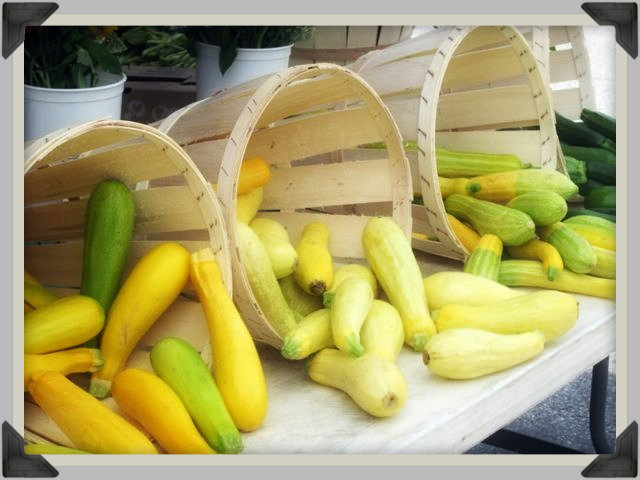
    farmers market squash and zucchini


    This is the story…

    of how our family was changed by our first year of deliberately eating food

    produced from the same place where we worked, went to school,

    loved our neighbors, drank the water, and breathed the air.

    -Barbara Kingsolver,
    Animal, Vegetable, Miracle: A Year of Food Life

    In early 2008 I took two books out of the library that changed my family. The first was Richard Louv’s Last Child in the Woods: Saving Our Children from Nature-Deficit Disorder. The second was Barbara Kingsolver’s Animal, Vegetable, Miracle. Her story is absolutely what inspired me to alter our story, and those two books are what inspired this blog.

    Kingsolver’s game changing, life changing story involves her family’s journey from the food desert of Arizona back to the land in Virginia, and their commitment to one year of living la vida local. It’s one part memoir, one part historical narrative, one part cookbook and one part political manifesto, with a healthy dose of ethical undertone thrown in for seasoning.

    After reading it, I…


    undertook my own eat local project

    …which eventually grew into a real love and appreciation of my co-op’s farmers market. I developed friendships with the farmers and small businesses I saw there week after week, felt really good about where my dollars were going, and have been asked to work with my local chapter of Slow Food USA this year to help others discover the joys of local food and like-minded companionship.

    learned to cook…

    … sort of. I’m still no chef, trust me, but I can cook lots of simple meals and have become brave enough to try more complex recipes and experiment with brand new ones. We embraced new foods like rainbow chard just because it was in season. My kids have been exposed to a whole world of tastes and textures that I never was, and they have learned to cook as well. It’s healthier for them on so many levels— the willingness to try new things, the ability to control their own sugar and fat intake as they grow older, and I can’t help but think that my boys will make such good husbands one day with their cooking prowess.

    tried to garden.

    I’m not very good at it, and every year Jeff announces that this is my last gardening attempt. Stick a fork in me, I’m done. I’m terrible about the upkeep, and the weeds pop up faster than I am willing to pluck them. Granted, there is a wonderful taste of victory when you cook and eat your own fresh green beans, heritage tomatoes, lettuce greens, basil and rosemary and parsley. There is also potential for soul-crushing defeat when deer consume your entire vegetable plot overnight just as your efforts begin to set fruit. I continue to plant those seeds and starters in spring, because to me there is no better symbol of hope… but for us, in our shade garden, it’s not the same symbol of freedom that it was for the Kingsolvers.

    stopped buying processed junk.

    Not entirely. But mostly, I eat real food. And I’ll preach that practice until the day I die. Our bodies have evolved, slowly, for generations, to efficiently use the nutrients found in food. To eat anything else is to willingly submit to volunteering your and your children’s bodies as guinea pigs for science experiments. This seems like hyperbole, but I’m not kidding. How many illnesses might be attributed to consistently consuming things our bodies aren’t fully equipped to process?

    stopped wasting food.

    Seriously. Now that I know how much effort goes into growing and cooking the stuff, throwing it out just kills me.

    changed my shopping habits.

    I’m far from perfect, but I buy mindfully, in the grocery store and everywhere else. I care a whole heck of a lot about who my dollar benefits and how my choices affect the earth. I strive to keep my money in the community, or at least supporting companies whose ethics I support.

    cherish food moments.

    Not every meal is a masterpiece, and to be honest I don’t cook special meals as often as I did when I first started all this (I wasn’t working full-time in 2008). But I do ask my kids to help me when I cook new things, and we eat them together, and remember them together later. Holidays are especially precious. Food and memory and emotion are all tied up together in our lives, and when you roll up your sleeves and work hard to produce something memorable, there is something glorious about that.

    What I still haven’t done…


    canning and preserving.

    I’ll come right out and admit it: I’m scared. I’m afraid of doing something wrong and poisoning us all. The lovely people at Ball sent me a starter kit— I think I won it somewhere, I can’t even remember— and it has been collecting dust for a year at least. This summer I swear I will have someone teach me.

    raised poultry.

    My favorite passages of Animal, Vegetable, Miracle involve turkey raising, and I’m not even going to tell you about them because I want you to read them. But I will say this: I learned from this book that turkeys are too stupid to have sex without human intervention. I already knew that chickens have been bred to have breasts so large, they cannot even support their own weight on their own two feet, meaning that those “cage-free” specimens at the grocery store are meaningless. I have friends who raise eyebrows at my willingness to raise and slaughter my own fowl, but at least I would know that those birds got a real life and a humane death.

    However, based on my inability to take care of a carrot bed, Jeff’s putting his foot down about the chickens I covet. We’ll see. Maybe in a few years, when the kids are older and can help out there.

    Rocking my thinking… again

    My first time reading Animal, Vegetable, Miracle I was fascinated by all the info that was new to me, by their project, and it propelled me into a new way of life. Reading it again, three years later, I was more struck by Kingsolver’s assessment after the year was over:

    If our special way of eating had seemed imposing at first, gradually it was just dinner, the spontaneous background of family time as we met our fortunes one day, one phone call, one hospital visit, wedding, funeral, spelling bee, and birthday party at a time. It caused us to take more notice of food traditions of all kinds— the candy-driven school discipline program, the overwhelming brace of covered dishes that attend a death in the family. But in the main, our banana-free life was now just our life…

    Our plan to make everything from scratch had pushed us into a lot of great learning experiences. In some cases, what we learned was that it was too much trouble for everyday… Altered routines were really the heart of what we’d gained.

    The difference between a book and a blog is that with a book you get to have closure, an ending.

    Sometimes with this blog I become discouraged; I don’t start a lot of new projects anymore. I don’t know what to write about because all this has become the backdrop of my life. It didn’t happen all at once; it was one step at a time, sometimes two steps back. But I find out-of-season, trucked-cross-country apples just don’t taste as good. When I go back to drinking soda, I feel yucky. And when we make our cakes out of a box, we all feel like we’ve cheated ourselves out of something more expensive, more time-consuming, more effort— but also just better for us, better tasting, better feeling.

    We’ve internalized so much and it has become normal for us, our routines have become forever altered.

    I’ll keep writing because I don’t think I can stop, just as I don’t think I could start eating apples flown in from New Zealand or buying factory-farmed chickens, even if they are hyperlocal. My hope has always been to inspire someone else to begin the journey, because if we could do it, surely you can.


    But if you wouldn’t mind leaving me a comment about what you’d like to know about?

    That would make my day.
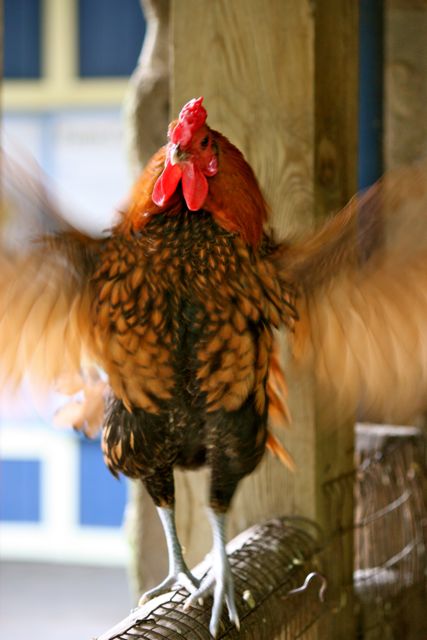
    hen flapping wings
    Hey you! Start squawking! Tell me what I should write about next!


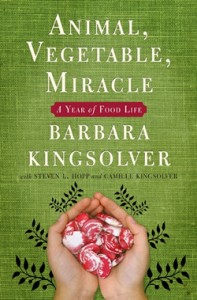
    Animal Vegetable Miracle book coverCould you live an entire year eating locally or the food from your garden? Barbara Kingsolver transplanted her family from the deserts of Arizona to the mountains of Virginia for their endeavor. Join From Left to Write on February 21 as we discuss Animal, Vegetable, Miracle: A Year of Food Life by Barbara Kingsolver.

    As a member of From Left to Write, I received a copy of the book to highlight and dog-ear and otherwise prep for future blog posts. All opinions are my own.
     

  • Easy Healthy Valentine’s Day Snack, plus Heavenly Dip Recipe

    Easy Healthy Valentine’s Day Snack, plus Heavenly Dip Recipe

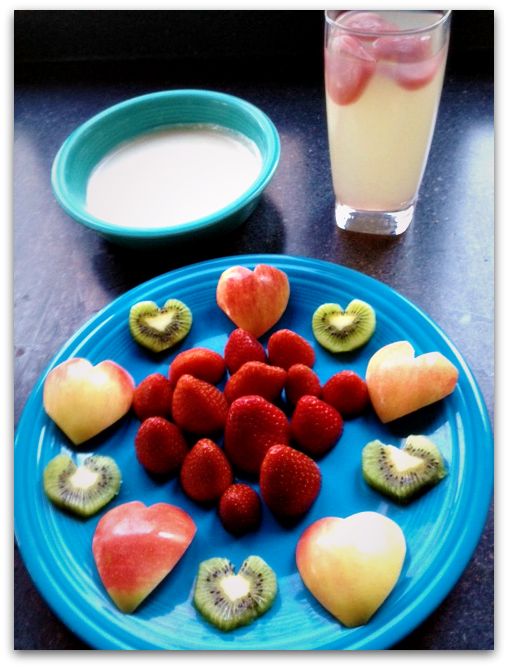
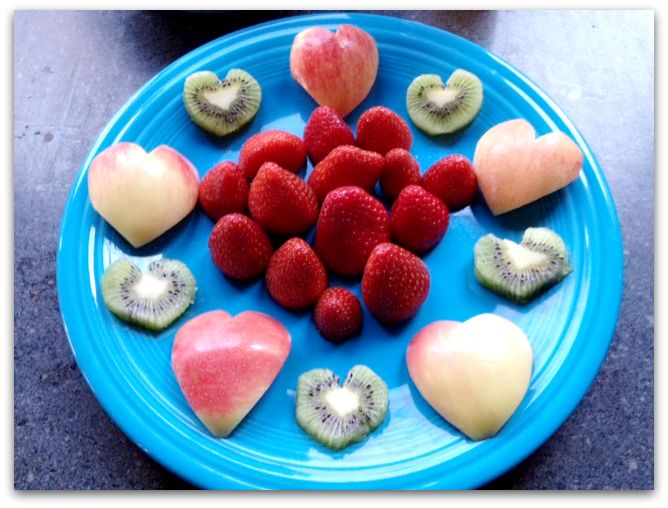
    healthy valentines day snack for kids


    Life’s greatest happiness is to be convinced we are loved.
    -Victor Hugo


    I always hated V-Day until the kids came along. But I love doing stupid little things for them on this day.

    (You can read my previous rantings about the dreaded day of romance here. Seriously, you want to click on that link, there’s a dirty picture of bugs. One of my favorites.)

    This year I’m showing some lovin’ with food… although really, don’t all mothers show their love through food every day?


    kid valentines day snack


    We’ve got kiwis and strawberries and Pink Ladies… organic lemonade with organic pomegranate juice ice cubes… and healthified Heavenly Dip.

    I don’t know if everybody calls it Heavenly Dip. That’s how they label it at my grocery store, and its cream cheese sweetness is one of my weaknesses. I will eat fruit all day and night as long as I have this dip on hand.

    I’m fairly certain the stuff at the grocery store is full of sugar and preservatives, so I trial-and-errored my way to a fresh homemade version.

    As always, I played it fast and loose with the measurements. Taste test to your heart’s desire.


    homemade fruit yogurt dip


    Homemade Heavenly Yogurt Dip

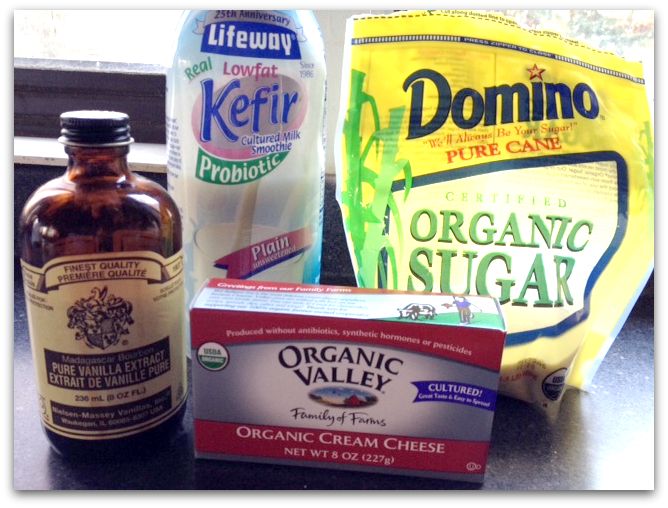
    • warm some cream cheese (in the microwave at half power for 30 seconds). I used about 1/3 of the bar.
    • add plain kefir (it’s low fat, full of calcium and protein) until smooth and stirrable
    • add sugar to taste (I didn’t use much, didn’t want to overpower the sweetness of the fruit)
    • splash with vanilla, because everything tastes better with vanilla
    • attempt to refrain from licking bowl clean.


    lemonade with pomegranate ice cubes


    I looove organic lemonade with pomegranate juice. Usually I make juices fizzy with carbonated water from our SodaStream (it’s a great way to stretch your juice dollar, esp when you’re shelling out for the organic versions; but it cuts down on sugar intake too. Just tell your kids it’s soda!).

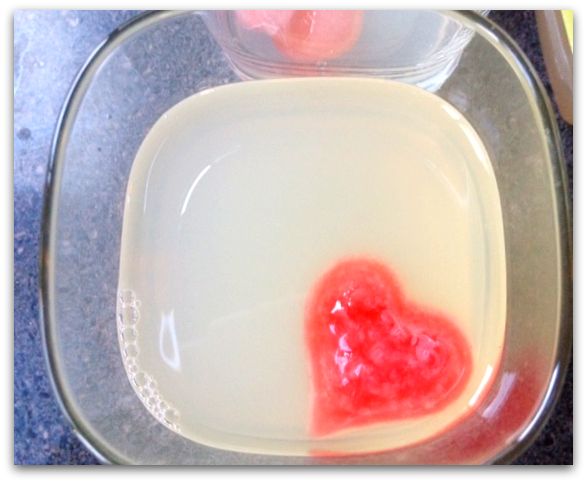
    For V Day I show the love with full-flavor lemonade; the pomegranate gets frozen in candy molds to make heart-shaped ice cubes.

    When the ice cubes melt, you’ve got pink lemonade 🙂

    (In the summer, freeze the lemonade into cubes… drop them into water or iced tea for a bit of sweet zing.)


    Sweets for the sweet!

    How are you showing your loved ones your heart today?


  • Wal-Mart’s Ready to Tell You What’s “Great For You”

    Wal-Mart’s Ready to Tell You What’s “Great For You”

    great for you icon

    To eat is a necessity, but to eat intelligently is an art.
    – La Rochefoucauld

    This week Wal-Mart unveiled its packaging featuring the “Great for You” symbol on their house labels, reserved for those foods that meet certain criteria:

    Single ingredient foods:

    • fruits or veg: fresh, frozen, canned, dried, 100% juice
    • 100% whole grain
    • unflavored low or no-fat milk & yogurt
    • lean protein (eggs, seafood, meat or poultry)
    • fats or oils, nuts or seeds whose calories that come from saturated fats total less than 15%

    Foods that contain a single ingredient food AND meet certain standards for:

    • fat content (no labeled trans, saturated fat account for less than 10% of calories, total fats account for less than 35% of calories)
    • sodium content  (380mg or less in single food item, less than 600mg for mixed dishes)
    • added sugars (no more than 25% of total calories).

    In a press release, First Lady Michelle Obama is quoted as saying that “the healthy seal will be another tool for parents to identify the best products for their kids. Giving parents the information they need to make healthy choices is a key piece of solving childhood obesity.”

    Only, this isn’t all the information parents need. My own opinion is that kids need the natural fats found in milk and dairy and nuts and seeds more than they need the processing and substitutes. I think canned foods should be avoided due to the BPA that can be found in the can’s linings. I think what a cow eats and how it was treated factors in as much as how high fat content of its milk or beef is— and that most of us could stand to eat less meat, period. I think sodium content naturally becomes much less of a concern when people concentrate more on eating food that remembers where it came from.

    And preservatives, chemicals, food colorings and other additives? Aren’t even being entered into the equation.

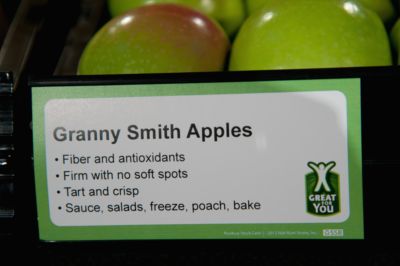
    Look, I have no problem with this:


    walmart great for you label


    Apples ARE great for you! I think everybody already knows that, though. Wouldn’t that money be better spent elsewhere?

    I do sort of have a problem with this:


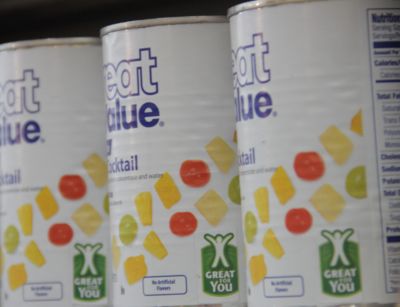
    walmart great for you label


    I’m sorry. Fruit cocktail is not as great for you as apples. That’s that and that there’s what it is.


    There’s no sense of degree.

    Fruit cocktail tends to have added sugars, preservatives, plus there’s that whole BPA in can linings issue. Quite simply it is not as “great for you” as apples— but both options carry the same label that’s supposed to set parental minds at ease about identifying the best foods for their kids.

    This reminds me of a recent shopping trip when Jeff stood in the organic aisle and remarked that he felt like he was allowed to buy anything he wanted from there. No, you can’t. Organic cookies are still cookies, and if you eat enough of them you’ll rot your teeth and get fat. Fruit cocktail may contain fruit, but it also contains sugar, and if you eat enough of it you’ll rot your teeth and get fat.


    There’s no sense of whole-diet.

    Yes, apples are good for you. But tons of apples are not nearly as good for you as apples incorporated into a well-rounded diet along with bananas, kale, blueberries, avocados, carrots and cabbage. There is a spectrum of nutrients that we need to derive from our whole diet— some of which we absorb better with fats, which are being given the cold shoulder in this scenario too.

    A person could easily only eat foods with the proper label and still have wholly incomplete nutrition. It’s all about balance and variety.


    There’s no sense of personal responsibility.

    Basically, I think this labeling system just makes it easier for people to make lazy choices. Rather than take control of our own heath, and responsibility for our own choices, it’s become as easy as “look for the funny little man.”

    When we grab things off the shelf based on whether it carries the “great for you” label, we deny our children education. They don’t see us flipping that package over to check for additives, or vitamin content, or to compare one brand’s sugar level with another. We’re not discussing whether the full-fat of one yogurt makes it a better or worse choice than a low-fat option with more sugar.

    We’re just automating our food choices further, putting our faith into the machine, and it’s that sort of mindless eating that contributes to the obesity problem to begin with.

    What happens when your kid goes to college and shops somewhere other than Wal-Mart? Will he be equipped to make the right choices then, or have we just delayed the problem?


    The problem isn’t Wal-Mart.

    My intention here is not really to knock Wal-Mart for not doing enough. They are doing something, and that does matter. They are attempting to make it easier and cheaper for people to get healthier foods and I do respect that (my issues with Wal-Mart having more to do with my disdain of big-box America in general).


    Sometimes there are no shortcuts.

    Slapping an easy button on something is not the same as educating the public about healthy choices and a well-rounded diet. It’s a form of enabling. Enabling people to make lazy choices and somehow feel good about it.

    I just want people to wake up and stop expecting everyone to make everything easy for them. Some things in life require education. They require you to care. They require discipline. Properly attending to your children’s health is one of them, and one of the biggest ways to care for your child’s health (and your own) is to monitor the food that enters your house.

    Care enough to learn. Learn enough to make a difference.


    What Wal-Mart could do better

    Superstores have buying power. I’d love to see big box stores throw their support behind local and organic— it’s those large orders and promises for the future that drive prices down. I’d like to see them refuse to buy BPA-laden products. And I’d like to see actual weekly meal ideas, that make for a comprehensively healthy diet over the course of 7 days, broken down into shopping lists. Maximize the nutritional buying power of food stamps. Offer cooking demonstrations. And maybe people could get an additional discount or bonus food when they purchase a set meal plan. Because if I’ve learned nothing else from the internet, it’s that people put a bargain above almost all else.

    The company has given more than $13 million in grants to organizations for nutrition education— worthy organizations like Share Our Strength, the National 4-H Council and Action for Healthy Kids. They estimate these grants will impact more than 300,000 people this year.

    I have no idea how many people shop at Wal-Mart and how much they spend, but I’m thinking that bringing those education efforts in-store would reach a heck of a lot more than 300,000 people a year.

    Stop telling people what’s Great For Them. Show them how to figure out what’s great for their health.


    What do you think?
    How do we get people to start reading labels—
    and interpreting them to make good choices?