Category: Food & Recipes

  • Getting into the (Eco) Spirit: ‘Green’ Beers, Wines, Alkie-hol

    Getting into the (Eco) Spirit: ‘Green’ Beers, Wines, Alkie-hol

    Wine is sunlight, held together by water. 

    -Galileo


    After guest posting on Type-A Parent about having a green, sustainable Christmas, I got a bunch of questions about eco beers, wines and spirits. I guess it’s an arena that some people hadn’t really considered greening before.

    Like anything on the green-eco-sustainable front, it’s a sliding scale of factors, and you will need to ultimately decide which ones matter most to you. Some liquor might fit all your needs, which is awesome, but I’m thinking there’s a small selection of “perfect.”

    I haven’t done a ton of research, I’m letting you know that upfront. This is just a down-and-dirty mind dump. More thorough resources are at the end.


    1. Is it organic?

    Imported grapes made it onto EWG’s 2011 Dirty Dozen list of fruits & veg you should buy organic, and a whole lotta grapes go into making wine. Like apple juice, we’re talking about a concentrated liquid, and that means concentrated toxins.

    Beer is made from barley and hops (and wheat if we’re talking wheat beer). There is a lot of pesticide and fungicide used (particularly with the hops), although I don’t believe it’s absorbed to the same extent a grape absorbs. Currently, a beer can be labeled organic if the barley/wheat was grown without chemicals but not the hops; this is being phased out and by 2013 an “organic beer” will be all organic ingredients.

    As always, my reminder here is that the real reason to buy organic is to limit not only our own chemical exposure but the impact those chemicals have on our soil, on our water supply, and on the farmers that have to handle it. Buying organic is more expensive, yes, but demand is how we collectively drive down price.

    2. Is it local?

    Liquids are expensive to shuttle around. They weigh a lot and have a large carbon footprint. Go domestic over imported, local over shipped from the other side of the country.

    Bonus points for small family-owned biz.

    3. How’s it packaged?

    There’s an up-and-coming trend of putting craft beers in cans that I don’t love; the idea is that it makes them more portable but should you be taking your alkie-hol hiking or on the road with you anyway? However, the lighter aluminum makes a difference in shipping weights and carbon footprint; we’re talking up to 30% less emissions.

    Apparently, aluminum also tends to get recycled more than glass, and glass requires more energy at first formation. BUT, glass is infinitely recyclable.

    (It’s a given that you’re recycling, right?)

    I can’t even start to wrap my head around how best to meaningfully crunch those numbers, but it looks like cans come out on top.

    Until you remember that the cans have an inner lining to keep beers from developing a metallic taste, and to me it seems like linings always turn out to have BPA involved.

    I’ll leave you to make your own decision, but if you’ve got local beer on tap at the corner pub? YOU WIN.

    4. Is the company sustainable?

    Are they recycling their byproducts? Do they use alternative, clean energy? How do they treat their workers?

    Do they make donations to charities you support? I have to give a shoutout to ONEHOPE wine, here. They donate half their profits to charity and YOU get to choose who gets the portion of YOUR purchase.

    I know these are pain-in-the-ass questions, but if you’re like me you’re already loyal to a few labels. Check them out. Remember that these issues matter to companies if they matter to YOU, because you vote with your dollar. And believe me, companies want your dollar.

    That doesn’t just go for liquor, folks.

    So what does Robin drink?

    Paradocx Wine

    I don’t drink a helluva lot of wine, but when I do it’s from a family-owned & operated local vineyard right here in Landenberg (I drive past it on the way to Jake’s school). It’s not organic, but is on a small-enough scale that I hope they don’t find broadly spraying necessary. They use drip irrigation rather than soaking for water conservation. And their wine is packaged in paint cans; when you finish your can you can turn it back in to be reused.

    They also run a CSA— if you’re local and into wine you should look into it. I like the white and the blush, but that’s not saying much; I don’t like any red wine that I can think of.
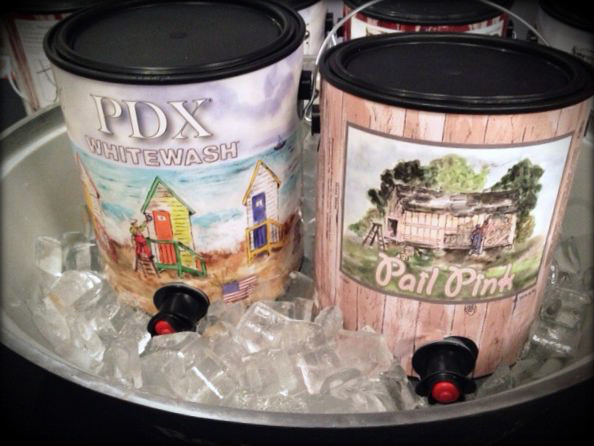
     

    local wine


    Blue Moon Beer

    I heart my Blue Moon. It’s not local but it’s my favorite. It’s brewed and packaged in Denver, and frankly I trust people in Colorado. I’ve been there and they take their eco-sensibilities seriously.

    It’s tough to tease out any info about Blue Moon as an individual operation, as it’s owned by MillerCoors:

    Striving to make more beer while using less water, reusing or recycling nearly 100 percent of brewery waste, it relies on each of its U.S. breweries to seek out the most efficient and environmentally sustainable brewing practices.

    It also tastes really good.

    blue moon beer
    Just an ordinary night, drinking my Blue Moon and hanging out with the potted plant. In the hallway.


    Beer Runner-Up— Sierra Nevada Pale Ale

    Not local. I should really get out and try some more local beers (mostly I just never buy beer when I’m eating out because it’s so expensive that way).

    Sierra Nevada is powered by solar and hydrogen fuel cells; if you go to their website you can see how much energy is being produced by either right now. It’s kinda neato.

    Death’s Door Spirits

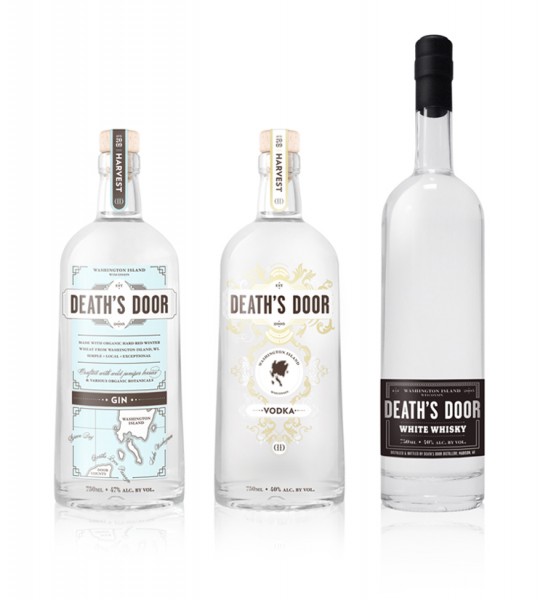
    I was introduced to this brand when visiting the Green House in Boulder. The vodka is straight up yum, described as “smooth and rich with subtle notes of vanilla.”

    Since 2005, Death’s Door Spirits and Capital Brewery have supported the farmers’ efforts on Washington Island to expand the acreage of hard red winter wheat from five (5) to 1,200 while two years ago organic certification was achieved for all of the crops.

    The wheat and barley are organic, the juniper berries are wild, and the ingredients are locally sourced to support local & small biz and to reduce overall carbon footprint. AND their stuff is tasty AND their bottles are kickass. Also? DEATH’S DOOR. Love the name.
     

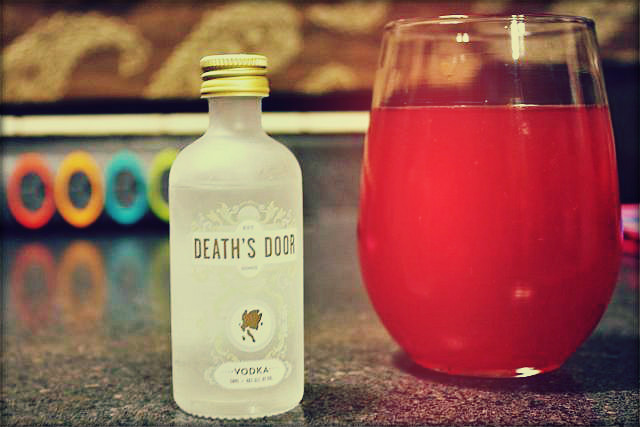
    To ring in the new year, I have to share my favorite drink of the moment (pictured at top).


    Death’s Door Pomegranate Lemonade

    • pomegranate juice (I buy Wild Harvest, which is Acme’s house brand for organic)
    • equal amount lemonade (I use Newman’s Own Pink Lemonade; organic and the pink comes from grape juice)
    • a healthy dose of Death’s Door vodka

    Antioxidants in the pomegranate! Profits from Newman’s Own going to charity! Supporting small farms! All organic, baby! This drink is full of WIN.

    You can’t even taste the alcohol; if anything this vodka adds a touch of sweetness to balance the tartness of the pomegranate and lemonade. Which can be a good thing or a VERY VERY bad thing.

    Don’t drink and drive, people. This one creeps up on you.

    Ever think about the pesticides in your alkie-hol?

    Will you look for the organic label now? Support local? Look for sustainability?


    ________________________________________


    Further Reading:

    Which Kind of Booze Is Best for the Planet?

    Organic Beer and Beyond: 10 Eco-Friendly Breweries

    Green Booze: List of Eco Alcohol
     

  • Breaking Bad Habits, with Help from Dad and GNC

    Breaking Bad Habits, with Help from Dad and GNC

    We are what we repeatedly do.

    Excellence, then, is not an act, but habit.

    -Aristotle


    Let me tell you a story.

    When I was little, and then not so little— from the earliest I can remember until I hit maybe high school— my father would lift weights on a rusty bench in our basement that was laughably simple compared to the sleek numbers they have today. I didn’t like the basement; it was cold and dark and somewhat damp, as basements tend to be. But I liked having my dad all to myself, and would sit on the steps, reading a book and spinning the wooden propeller we had pinned to the side of the third stair from the top, out of his sight.

    I was somehow reassured by the clank of the weights being lifted and replaced, the steady breathing on each repetition. Keep in mind, my dad was a portfolio manager at a bank, and he was not a big man by any means. This clandestine weightlifting was proof in my mind that he was some sort of superhero.

    Every so often, we would walk to Prices Corner, a shopping center 6.4 miles away (I just looked it up on Google maps). We’d spend a looong time there, me just idly picking stuff up off shelves and reading them; him deciding what vitamins and supplements and proteins he wanted. And then we’d walk the 6.5 miles back. This seems crazy in retrospect, but it was perfectly normal to us then.

    The Aristotle quote I opened with is one that my dad brought up all the time, especially when it came to shooting baskets. The other one he liked a whole helluva lot was one about it taking 30 days to form or break a habit.

    I tell you all this because it may seem incongruous for me to speak about protein shakes and vitamins on a “green” blog, but honestly that possibility didn’t strike me until I sat down and started writing this. GNC and its products have a long history in my family; my brother gives my husband Muscle Milk for Christmas; we know and trust them.

    That was all prologue. Now comes the review as I intended it.

    Generally speaking, my habits lately have not been excellent. What I have been repeatedly doing is shooting myself in the foot, health and energy-wise. It’s a long boring story but the upshot is that I keep taking naps that perpetuate a cycle where I don’t sleep, I semi-function on a series of naps.

    GNC sent me a box of goodies as part of the #LiveWellNow campaign, and I’ve been using their products to help break my bad habit cycles and live well… now. Dad always said it takes 30 days to form a habit, so I’ve mindfully altered my routine for one month in the hopes of entering 2012 with a healthier body and a better mindset. Here’s the skinny.

    1. It Starts With a Healthy Breakfast

    Confession: I’m not a breakfast eater. Since I was like, 16, I’ve been drinking my breakfast (at least one strong cuppa coffee, usually two). I don’t like eating food in the morning. It’s not a time issue; I’ve gone through periods where I’ve tried, cooking myself a nice omelet or pouring out some cereal, but I just pick at it. Then, I often forget to get any lunch, and then I eat a TON at dinner. My dinners are usually pretty healthy, but that’s not the issue: my metabolism and energy levels are all over the place and I feel like @ss in the late afternoons. You know, when Jeff and the kids get home and I’m expected to shoot hoops and cook dinner.

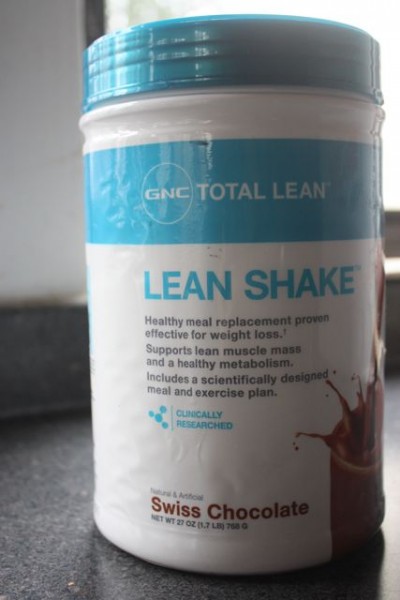
    GNC sent me some Total Lean Lean Shake in Swiss Chocolate:

    • Healthy meal replacement proven effective for weight loss
    • 9 grams of high quality protein
    • Supports lean muscle mass and a healthy metabolism
    • Includes a scientifically designed meal and exercise plan

    The instructions do not dictate “a shake for breakfast, a shake for lunch, and a sensible dinner,” but rather a small portion of something (usually a fruit) with the shake and healthy snacks like yogurt figure in. The idea is that the shakes replace the meals people usually eat at breakfast and lunch; for me, it actually forces me to eat something. Healthy changes are different for everyone.

    It tastes like a protein shake. It’s a distinctive taste. However, it doesn’t have the chalky aftertaste that I remember; it’s really not bad. I don’t eagerly await shake time and drink it with exaggerated YUMs, but I don’t mind it. Using only 8 fl oz of water, I toss mine back in three big gulps.

    TIP: Unwilling to dirty and wash a blender 2x daily, I whip my shakes up with an eggbeater (that I received as a 15th birthday present from a friend with a sense of humor, and no sense that this gift would continue to be used 2 decades later). Blends it perfectly. Don’t have an eggbeater? If you have young kids, you should totally get one— requiring 2 hands, this utensil is a great way to get kids safely involved in the kitchen and working those small motor skills. Otherwise, a wire whisk will get you much better results than a spoon.

    2. Take Your Vitamins

    Research shows that people who take vitamins tend to be healthier than those who don’t. It also suggests that this is because the type of person who takes vitamins is already thinking about their own health, and making other healthy choices. The jury is still out on just how well your body processes vitamins in pill form; it’s generally accepted that we’re engineered to make better use of vitamins as they occur naturally, in food.

    Ideally, I’d get all my vitamins and nutrients from food, but currently I lack the time and frankly inspiration to prepare all that— especially since my husband and kids have different specific needs than I do, and they would likely not eat much of it anyway. (Which always throws me into a spiral of depression, when I cook stuff and they don’t eat it. Am I alone here?) So my thoughts here are:

    • prepare and eat a large variety of foods that contain a spectrum of vitamins and minerals
    • take my vitamins anyway, to fill any gaps
    • take them with my dinner, as yet another way to model by behavior that I care about my own health so that my kids will take their own health seriously.

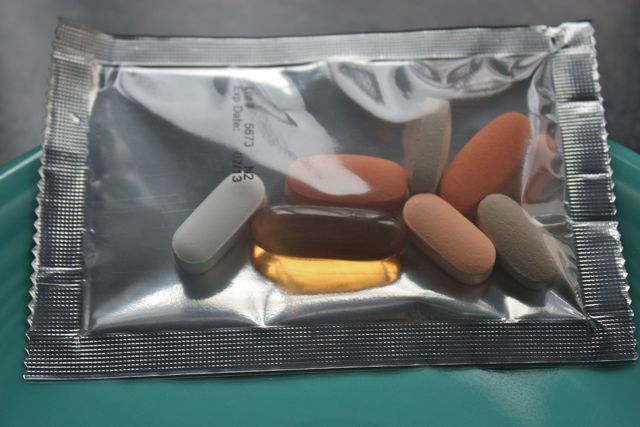
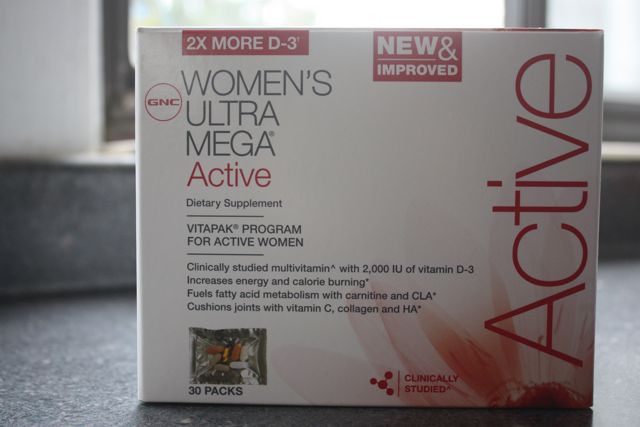
    GNC helps me out with Women’s Ultra Mega Active Vitapacks:

    • Clinically studied multivitamin with 2,000 IU of vitamin D-3
    • Increases energy and calorie burning
    • Fuels fatty acid metabolism with carnitine and CLA
    • Cushions joints with vitamin C, collagen and HA

    Amusingly, when I read this off to Maverick he told me this was “perfect for me” because I need energy, calorie burning and joint cushioning (basketball in my tweens and early teens messed my knees up something fierce). Jeff expressed concern about my being able to take “those horse pills.” It’s true, they are pretty big pills, but they’re coated in something not unpleasant that help them to go down pretty easily, and they’re not loaded with iron so I don’t feel nauseous after taking them. The pack feature makes them awesome for travel (I usually travel with a veritable medicine cabinet).

    NOTE: This pack contains caffeine from different tea extracts. I’ve actually successfully weaned myself off my morning coffee, but still needed a Pepsi with dinner to keep moving. I drink Throwback, which has sugar instead of HFCS, but still has all the calories. Taking this Vitapack with dinner perks me back up, cutting out that 150 calories and 40g of sugar. If caffeine isn’t your bag, baby, other Vitapacks are available (Wellness, Beauty Enhancing, 50+, etc). I hope that one day I’ll get enough sleep that I won’t need that caffeine boost, but until then… well, a caffeinated mommy is a happy mommy, and if Momma ain’t happy ain’t nobody happy.

    3. Sowing the Seeds of… Ch-ch-ch-chia

    Yeah, totally the stuff we bought as gag gifts for our friends who didn’t want seemingly extraneous kitchen utensils.

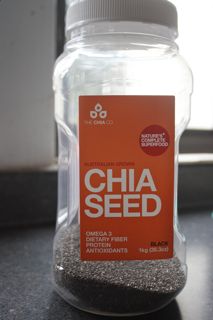
    Chia seed is the new superfood, and its benefits seem to be twofold:

    • it’s full of fiber, so when added to food it makes you feel fuller, longer
    • it’s full of omega-3s, even more so than flax seed. And it has calcium, phosphorus, magnesium, manganese, copper, iron, molybdenum, niacin, and zinc.

    It’s crazy versatile, too. Just sprinkle over your food. That’s it. There’s some added crunch but no discernible taste. Or, add some water to make a gel, and then incorporate into liquids (just in the last 24 hours I’ve seen a recipe for a salad dressing that approximates Brianna’s Rich Poppy Seed Dressing, one of my faves, and another for mini healthy cheesecakes with a cherry topping that uses chia gel).

    If you’ve got picky eaters and are into the whole sneaky chef thing (which I don’t totally advocate but that’s a separate blog post), chia seems like it would be outstanding in that respect. It’s also sold in white, so easier camouflage.

    TIP: If you have kids in the house, they are gonna find this stuff fascinating. ALWAYS PICK THE JAR UP BY THE BASE. Do NOT, as I did, grab by the lid… as some child has probably just reached in and grabbed a handful to scatter on something. Chia seeds: fun to eat. Not so fun to sweep up off the kitchen floor.


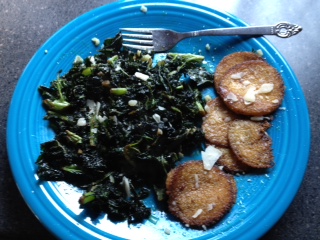
    Kale and polenta rounds sauteed with garlic; chia sprinkled in with the kale; parmesan shavings over all. Don't judge. It was delicious.

    To recap:

    1. Thanks to the shake regimen, I’m getting nutrients, liquid and a bit of healthy food at breakfast and lunchtime, helping to moderate my energy levels and metabolism.
    2. I’m taking my vitamins.
    3. The vitamins contain caffeine, eliminating my need for an evening soda and fueling my standing date with Jillian Michaels and her 30 Day Shred.
    4. The chia doesn’t directly correlate to a healthy habit I’ve formed, other than adding a nutritive boost to my meals. But it serves as a way to interest my kids in nutrients and makes healthy eating sorta fun.
    5. As a cumulative result of daily exercise and mindful eating, I’ve dropped five pounds and 1.5 inches in the waist.

    And New Year’s is still over a week away 🙂

    Why wait to resolve to be better? Start thinking about how you want to live well NOW. Invariably one small change leads to another.

    What small changes will you make— what bad habits can you break— to model a healthy lifestyle for your children? To strive for excellence?

    ____________________________________

    Disclosure: I’m Community Manager for FitFluential LLC, and GNC is a client of FitFluential. I received these products at no charge for review purposes; I asked to participate because I believe in this company’s philosophy of being pro-active when it comes to health and wellness. All opinions (1775+ words worth, yikes, sorry) are entirely my own. Well, maybe a little bit my dad’s.

  • One in Three Kids is Overweight. Why? (Infographic)

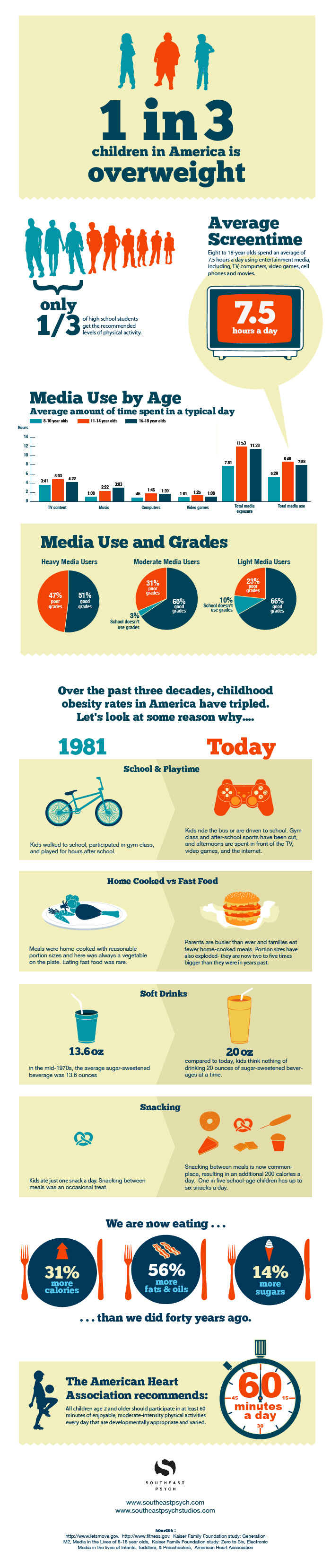
    One in Three Kids is Overweight. Why? (Infographic)

    Not shockingly, a combination of too much (crappy) food and not enough exercise.

    Soooo… what are we gonna do about it?

    [Via Food Wise & Southeast Psych childrens health in america]