Blog

  • Backyard Wildlife: Pileated Woodpecker

    Backyard Wildlife: Pileated Woodpecker

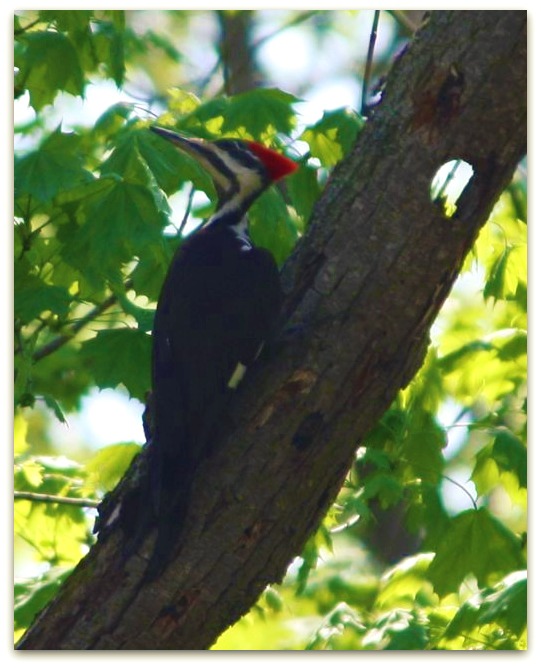
    pileated woodpecker

    Use the talents you possess—

    for the woods would be a very silent place if no birds sang except for the best.

    -Henry Van Dyke

    When I was a kid my dad would take us hiking. (Since we had no car, this first involved walking 6 miles to the park in question. And then 6 miles back home. Yes, I’m still bitter.)

    Every so often, he’d motion for us to stop and be quiet. “Do you hear that?”

    And we’d listen for the far-off drumming of a woodpecker.

    I never saw a woodpecker until we moved here. But now? I see them every day. Every morning at 10am I take part in a conference call and just outside my bedroom window, two pileated woodpeckers are having a grand ol’ time, chattering and laughing away as they look for a mid-morning snack. I can’t even begin to imagine what my co-workers must think is going on over here.

    Daily Woody Woodpecker marathons?
     

    In any case, apparently these woodpeckers weren’t commonly seen around here when I was young, but their numbers have filled out nicely and most alert birdwatchers have a good chance of spying one while strolling through the woods.

    A 100% chance if you happen to be strolling by my bedroom window at 10am on a weekday.
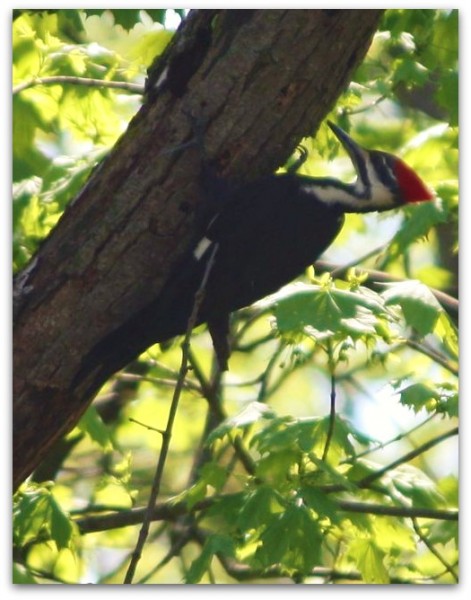

    female pileated woodpecker


    Quick Pileated Woodpecker facts:

    Crow sized: 16-19″ long

    This photo is a female; her “mustache” is black. On a male it would be red.

    Woodpeckers have stiff tail feathers to counter-balance their drumming. The tips can puncture paper.

    The bones of woodpecker skulls are super-thick and surrounded by super-strong muscles. This is how they avoid massive migraines. (You know you were wondering.)

    Their tongues are twice as long as the beak and coated with sticky saliva, as well as equipped with barbs and bristles. Think of it as a bottlebrush scrubbing your trees of insects.

    Pileated woodpeckers are long-term monogamous and share egg incubation duties.

    If you want to entice visiting woodpeckers to set up shop in your yard, I’ve seen them enjoying dried corn cobs, sunflower seeds, peanuts and those caged suet blocks.

    These birds eat the insects from and nest in dead wood, primarily. The worst threat to them as a species is the continued practice of clearing away dead trees.

    In spite of the slam I took with my quote there at the open, their call, while not lovely, makes me smile inside every time I hear it.


    This is footage of a woodpecker laugh I got from YouTube. I should say that I have got to the point where I can distinguish between our two by their call, so when I listen to this  I think, “That’s not quite right.” Much like human voices, I guess. I’ll have to get them on video. They banter back and forth and I always imagine they’re telling jokes and then throwing their head back with laughter.

    It’s saying things like that, I suppose, that make me seem endearing to those who know me well. And crazy to those that don’t.

    What’s made you smile today?

    ————————————————————————–
     

  • Get Outside! 14 Citizen Scientist Projects for Kid Backyard Naturalists

    Get Outside! 14 Citizen Scientist Projects for Kid Backyard Naturalists

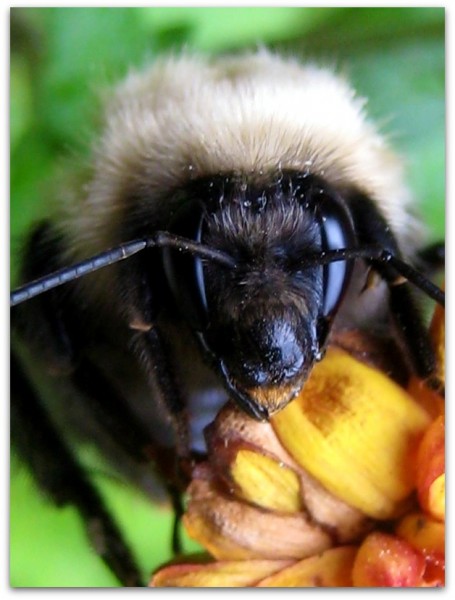
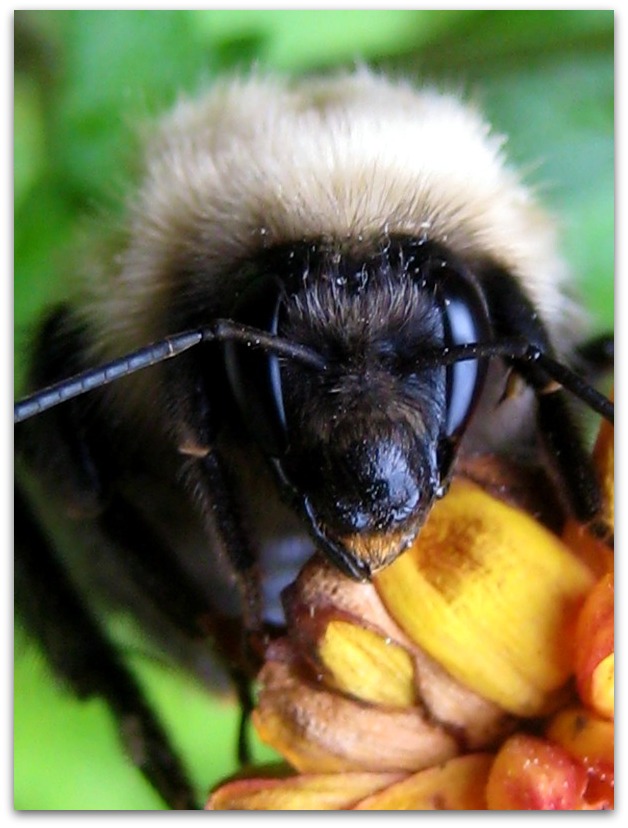
    bee on flower

    If we want children to flourish, to become truly empowered,
    then let us allow them to love the earth before we ask them to save it.

    -David Sobel

    Back in June of 2008 I read Richard Louv’s Last Child in the Woods: Saving Our Children From Nature-Deficit Disorder, and I pledged that my kids and I would become backyard naturalists: learning what we could about the life that graces this plot of land we call ours. Their names, their habits, their needs.
    In a blog post discussing the book, I pointed out:

    Louv worries about the abilities of future generations to see problems in the environment as they occur; if no children are skimming ponds for tadpoles, how will they know when those numbers begin dropping? If they are not learning to identify and name insects and wildflowers, will they notice when they are gone? If they are not outside at night to hear the spring peepers, who will sound the alarm when the night air is silent?

    “[What is the] extinction of a condor
    to a child who has never seen a wren?”
    -Robert Michael Pyle

    (Yeah, I totally just quoted MYSELF quoting someone else there. Did the ego involved cause your head to explode?)

    If you’d also like your children to become familiar with the life all around them, to help scientists track population data so that we are better able to help sustain that wildlife for generations to come, AND to get active and outside, here are some “citizen scientist” projects to consider:

    Birds

    • Celebrate Urban Birds
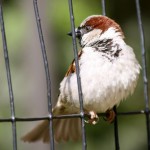
      sparrow on fenceChoose an area approximately the size of half a basketball court & watch for 10 minutes. Report which birds you see to the database, along with info describing your birdwatch area. That’s it! Receive a Celebrate Urban Birds kit– poster, info on urban greening, bird ID guide, sticker and sunflower seed packet– upon sign-up.
    • Project PigeonWatch
      Much like Celebrate Urban Birds, but focusing on pigeon numbers, color morphs, and courting behaviors. Pigeon kit is download only.
    • NestWatch
      Collect and submit information about nest site location, habitat, species, and number of eggs, young, and fledglings.
    • Operation RubyThroat
      Hang out your hummingbird feeder and submit data about migration dates and nesting.
    • Christmas Bird Count
      Join tens of thousands of volunteers nationwide as they count birds from mid-December through early January.

    Bugs

    • The Lost Ladybug Project
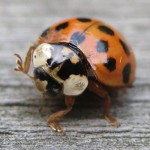
      Submit photographs of ladybugs along with info about the discovery site.
    • The Great Sunflower Project
      Sign up to receive Lemon Queen sunflower seeds. Plant these easy-to-grow seeds and once your sunflowers have bloomed, watch to see how many bees come to visit in a 15-minute period.
    • Butterflies and Moths of North America
      Share “clear, high quality close-up photographs” of butterflies, moths, caterpillars, eggs, or pupas.
    • Firefly Watch
      Observe your backyard or any other site and report the prevalence of fireflies. Great way to spend a summer evening!

    Everything else!

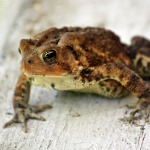
    • brown toadWildlife Watch
      Let the National Wildlife Federation know about the wildlife & plants where you live. Optional: share your nature stories and your photos in their Flickr group.
    • Project BudBurst
      “Adopt” one or more local plants and report different stages of its life cycle (budding, blooming, fruiting etc) to help collect data about changing environments and climate change. There is a scaled-down version for little ones called BudBurst Buddies; those who participate receive a certificate signed by Project BudBurst scientists.
    • Project Squirrel
      Log your squirrel sightings to help scientists better understand the ecology of neighborhoods.
    • JellyWatch
      Tell marine biologists about any jellyfish, red tide, a squid, or other unusual marine life you spy in the ocean.
    • Project Roadkill
      Boys of a certain age will gravitate towards this one. Including the deceased members of our wildlife family paints a more accurate picture of population numbers.


    It’s fun! It’s easy! It’s free!

    Most projects require no more than an internet connection, a few minutes of your time and the willingness to learn about your local wildlife. All those listed can be carried out no matter where you live (well, you need to be near an ocean to report jellyfish.). Keep in mind that ZERO is a number that needs counting too!

    Empower your kids to make a real contribution by helping researchers determine those areas and species most in need of support. (During the summer months, this can easily be extended into a science project or a math graphing exercise. Fights off the inevitable “I’m bored”s, as well.)


    Turn those backyard naturalists into junior citizen scientists!


    ————————————————————————

    All the citizen science projects I’ve listed here are nationwide. If you know of any projects local to your area, please share them in the comments.

    ————————————————————————


  • We Made It: Homemade Pop-Tarts

    We Made It: Homemade Pop-Tarts

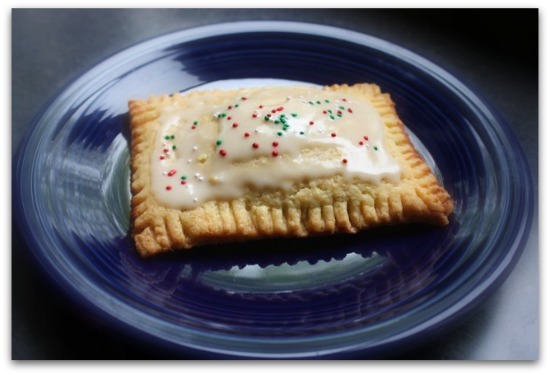
    homemade pop-tarts

    ‘When you wake up in the morning, Pooh,’ said Piglet at last,
    ‘what’s the first thing you say to yourself?’

    ‘What’s for breakfast?’ said Pooh. ‘What do you say, Piglet?’

    ‘I say, I wonder what’s going to happen exciting today?’ said Piglet.

    Pooh nodded thoughtfully.

    ‘It’s the same thing,’ he said.’

    –A. A. Milne,  The House at Pooh Corner

    Pop-Tarts are one of those things that the kids and Jeff always circle on the store circular, as though I might absent-mindedly add them to my list and therefore my cart. Personally, I just don’t like them and never have (preferring Toaster Strudels), but they are so not real food. They are basically sugary, doughy coasters with 200+ calories a pop, and I’ll never understand the appeal.

    Especially with this list of ingredients:

    ENRICHED FLOUR (WHEAT FLOUR, NIACIN, REDUCED IRON, THIAMIN MONONITRATE [VITAMIN B1], RIBOFLAVIN [VITAMIN B2], FOLIC ACID), CORN SYRUP, HIGH FRUCTOSE CORN SYRUP, DEXTROSE, SOYBEAN AND PALM OIL (WITH TBHQ FOR FRESHNESS), SUGAR, CONTAINS TWO PERCENT OR LESS OF CRACKER MEAL, WHEAT STARCH, SALT, DRIED STRAWBERRIES, DRIED PEARS, DRIED APPLES, CORNSTARCH, LEAVENING (BAKING SODA, SODIUM ACID PYROPHOSPHATE, MONOCALCIUM PHOSPHATE), CITRIC ACID, CORN CEREAL, GELATIN, PARTIALLY HYDROGENATED SOYBEAN OIL†, CARAMEL COLOR, MODIFIED CORN STARCH, SOY LECITHIN, XANTHAN GUM, MODIFIED WHEAT STARCH, TRICALCIUM PHOSPHATE, COLOR ADDED, TURMERIC COLOR, VITAMIN A PALMITATE, RED #40, NIACINAMIDE, REDUCED IRON, PYRIDOXINE HYDROCHLORIDE (VITAMIN B6), YELLOW #6, RIBOFLAVIN (VITAMIN B2), THIAMIN HYDROCHLORIDE (VITAMIN B1), FOLIC ACID, BLUE #1.†LESS THAN 0.5g TRANS FAT PER SERVING

    But, the kids like them and I am trying to not win the title of Meanest Mom in the World this year, so we gave the Pop-Tarts the homemade treatment. For our first time out, we tried classic Strawberry with Frosting. Next time we’ll try using Nutella as a filling; or some semi-sweet chocolate chips & marshmallows to make S’Mores; or maybe cinnamon sugar (I think the corresponding Pop-Tart would be Brown Sugar?).

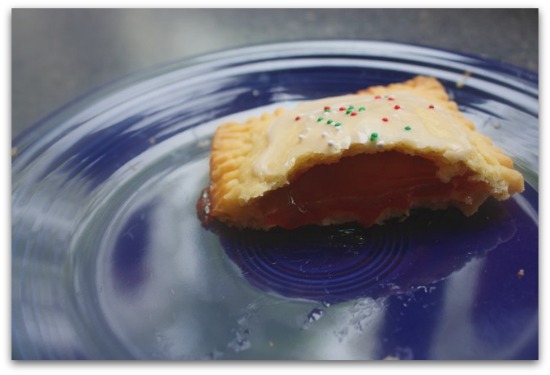
    The results were delicious: buttery and satisfying but not sickeningly sweet.

    My dough was imperfect, as my rolling skillz leave something to be desired; you would want cold chunks of butter to remain in the dough for a truly light and flaky crust. I overworked it and the butter all incorporated somewhat, but happily the dough and my kids were forgiving: the texture was a fair representation of a true Pop-Tart. And it tasted just fine.

    Homemade Strawberry Pop-Tarts

    adapted from the Tasty Toaster Tarts recipe at King Arthur Flour

    For the pastry: poptart
    2 cups all-purpose flour (preferably unbleached)
    1 tablespoon sugar
    1 teaspoon salt
    1 cup (2 quarter-pound sticks, 8 ounces) unsalted butter, keep cold until last minute
    1 large egg
    2 tablespoons milk
    Another large egg, for brushing onto pastry

    For the jam filling:
    3/4 cup (8 ounces) strawberry jam (I went with a no sugar-added organic)
    1 tablespoon water
    1 tablespoon cornstarch

    For the frosting:
    1/2 cup confectioner’s sugar
    1 teaspoon milk
    1 teaspoon light corn syrup (yes, I know, corn syrup. Looking into alternatives that don’t involve raw egg)
    dash of vanilla extract (warning, you will lose your perfect white coloring)

    — First make your filling by mixing the cornstarch and water together and adding to the jam. Bring to boil in a small saucepan, simmer for two minutes, then allow to cool.

    — In mixer fitted with the paddle attachment, combine the flour, sugar, and salt at low speed. Chip off  bits of butter (like 1/2 Tbsp chunks) and add until the mixture holds together, with good-sized lumps of butter still visible.

    –Whisk together one egg and the milk, and add it to the dough, mixing only until combined. Remember, you want to retain those lumps of butter for flakiness.

    –Divide dough in half; (the King Arthur recipe helpfully notes that each half will weigh about 10 ounces). On a lightly floured surface, roll each half into approximately a 9″ x 12″ rectangle, 1/8″ thick (use a 9 x 13 pan as a guide).

    –Lightly score lines onto the dough to mark thirds lengthwise and widthwise (so you have nine 3″x4″ squares). I used a ravioli cutter to mark my lines; King Arthur suggests lightly leaning a ruler into the dough. Beat egg and brush onto pastry.

    –Spoon a dallop of jam filling into the middle of each square.

    –Place the second sheet of dough over top and seal firmly around each filling mound by pressing with fingertips. Cut between mounds to make 9 pop-tarts (ravioli cutter rocks the awesome here). Press the edges shut, then press again with the tines of a fork. Prick the tops twice with the fork so steam can be released. Transfer to parchment lined cookie sheet and refrigerate. Preheat oven to 350°.

    –Bake 25-30 minutes or until golden brown. Allow to cool; meanwhile mix together your confectioner’s sugar, milk and corn syrup for the frosting (I added a bit more milk for a thinner consistency). Ice, add sprinkles or nonpareils if ya got ’em, enjoy!

    eating homemade pop-tart

    Part of a new series where I make homemade versions of mass-produced treats.

    Ideas and success stories welcome.

    Check it: I’ve added this post to the Real Food Wednesdays linky at Kelly the Kitchen Kop. You know you want to see what else is posted because that blog name is made of awesome.