Category: Food & Recipes

  • Buying Organic Meats and Produce: Why Bother?

    [Portrait of Enric Madriguera and Patricia Gilmore on their farm, Connecticut, ca. June 1947] (LOC)

    Tell me what you eat and I will tell you what you are.

    –Anthelme Brillat-Savarin

    I saw this on Twitter last night:

    Anything you have to peel— onions, bananas, garlic— is low in pesticides. Organic is a waste! 7 Supermarket Rip-Offs: (not giving the link traffic, sorry)

    This is classic “not seeing the forest for the trees.”

    It’s true. When you peel away the outer layers of something, you reduce the pesticides YOU ingest.

    While the amount of chemicals you consume along with your foods is worth thinking about, this is NOT the reason I buy organic.

    Sure, babies are born “pre-polluted,” with studies of cord blood finding nearly 300 different chemicals contaminating it:

    Of the 287 chemicals we detected in umbilical cord blood, we know that 180 cause cancer in humans or animals, 217 are toxic to the brain and nervous system, and 208 cause birth defects or abnormal development in animal tests. (source)

    Sure, there are about 80,000 chemicals currently on the market, and only about 200 have been tested for safety.

    Sure, we’ve no idea what happens when these chemicals bio-accumulate over time, or what happens when the chemicals in our body burden interact with each other.

    Scary as that is— that’s not why I buy organic either.

    Because there are always going to be studies and tests that say, this is fine for you, and these levels of pesticides are OK, and whatever, and I just don’t have the time or inclination to stay on top of the latest and greatest and argue with detractors.

    This, however, I think is inarguable:

    All those chemicals and pesticides are going somewhere for sure, and do you know where that is?

    Into our soil, our water and our air.

    And into our farmers, and our farmers’ children.

    (Not to mention, into you. And your children.)

    So when I buy organic produce, I do it to support farms that don’t knowingly pollute. Who don’t force their workers and families to handle dangerous chemicals on a day-to-day basis.

    And when I buy organic meats, the principle is the same. The bio-accumulation of chemical-laden feed worries me, but my main concerns are the ethics of the farmers. How do they treat their workers? Are the animals handled humanely? (Aside: it’s a nice bonus that happy cows and pigs tend to taste SO MUCH BETTER than their factory-farmed counterparts.)

    Yes, organics are more expensive. It simply costs more to take care of things properly, to oversee a farm rather than “spray and pray.” The price you pay is the true cost of healthy, ethical eating. Of quality.

    When your roof is falling, do you go for the cheap fix? When your child’s tooth is hurting, is your first concern “Do I have a coupon for this (regardless of quality of care)?” Why do we accept sub-par quality in favor of unnecessary quantity when it comes to what we feed our families?

    Discounts? Cheap beef? That’s corner-cutting, compromises made on morality and health that may save you a few pennies now, but will cost you in doctor’s visits in the long run:

    • cancer rates are up 50% since the mid-90s
    • allergy rates, 18%
    • instances of gout have doubled
    • In 1994, about 23% of the population was obese. Today, about 33%. At that rate, by 2030 half of the population will be obese, and health-care costs will be astronomical as millions of people develop type 2 diabetes, heart disease and cancer due to their diet.

    We need to start eating mindfully. We are what we eat.

    I know money is tight all over, so try these tips:

    –Save on organic produce by buying from farmers’ markets and staying in season; this year I’m going to try canning and freezing.

    –Incorporate more grains (rice, quinoa, whole wheat pasta) into your menu plan, so meat portions don’t need to be as big for your meal to be filling.

    –Buy organic meat online from a reputable source or from ethical, local farmers in bulk to freeze.

    –Designate one day of the week (or more!) as meatless.


    Do you buy organic meats and produce?
    What are your reasons?

    _________________________________________________________

    Disclosure: I am participating in a blogger campaign by Bucks2Blog and was compensated for my time. However, all views and opinions are my own.
     

  • Vegetable Deception, Yay or Nay?

    Vegetable Deception, Yay or Nay?

    salad

    The colors of a fresh garden salad are so extraordinary,

    no painter’s pallet can duplicate nature’s artistry.

    -Dr. SunWolf

    Once a week for three weeks, researchers from Penn State snuck puréed veggies into the lunches of 40 preschoolers.

    The kids ate the same amount by weight regardless of veggie content, doubling their veg intake and reducing their calories by 11%.

    70% rated the veggie-enhanced meals as OK or yummy, when asked.

    So, obviously the takeaway is that kids will eat veggies and not hate them, but before you run out and buy your copy of Deceptively Delicious or The Sneaky Chef I want to throw my two cents in…

    I hate the whole idea of vegetable deception.

    This stems partially from the fact that my mom was constantly telling me things were chicken and then cackling that I’d eaten mussels or whatever (meaning I had a very night ahead of me, as I can’t stomach shellfish).

    But it also just strikes me as doing our kids an injustice. Vegetables are good, y’all. They’re tasty. They’re visually satisfying. They come in their own all-natural packaging. Most require only minimal prep.

    But they’re an acquired taste, meaning that a person has to try them at least ten times before they get used to the flavor, and probably more before they enjoy and crave it.

    If you’re smothering that taste in something else until it becomes imperceptible, kids aren’t getting those initial flavor trials in. And if they don’t try them now, while they’re young and impressionable and eager to please… the likelihood of them ever trying on their own just dive off a cliff.

    It doesn’t matter if you double your kid’s broccoli intake now if he’s never gonna try broccoli later. Will you be sneaking veggies into his pasta sauce when he’s a teen? What happens when he’s making his own meals? Will he even know how to make those veggies palatable on his own?

    No, this is playing the short game; taking the easy way out.

    Parenting is hard. It means being unpopular. It means having to think of creative ways to serve up vegetables so kids will eat them. It means serving snacks and meals that are only vegetables so kids will eat just because they’re hungry.

    I’m not gonna lie, it’s an ongoing battle at our house, too. Here’s a few tips I’ve picked up over the years…

    Grow your own.

    It tastes better, for one, but kids are more likely to appreciate and try the veggies they’re cared for with their own two hands.

    Buy your own— at farmer’s markets.

    There’s a larger selection, and again, kids are more likely to appreciate and try the veggies they have a relationship with (“these came from the nice lady with the black lab”). I’ve also found that the farmers at my market are nice enough to offer samples my kids can’t refuse, and they suggest ways to cook things that I’m unfamiliar with. The kids are usually pretty open to these suggestions (more so than the things I come up with on my own). Take your kids to the market, ask for recipe tips, make sure the kids see and hear.

    Choose your own– at the grocery store.

    My kids trade off whose turn it is to go to the grocery store, and whoever the (ahem) winner is that week gets to choose stuff like the cereal for the week and the produce we buy. Maverick likes to pick out the weird stuff we’ve never tried, like horned melon. To be honest I was the one who balked at eating that one 🙂 The kids couldn’t wait to cut into the exotic fruit.

    Get the kids cooking.

    I think kids should start cooking at as early an age as possible. It instills a knowledge of how much work goes into your preparation of a meal on a nightly basis, which means they’re less likely to arbitrarily turn up their nose at whatever is served. But they’ll also eat a few bites of a dish they’ve prepared themselves.

    Be adventurous.

    Let the kids pick out a recipe to try. Sometimes they’ll be successes… and sometimes they won’t. This is such a great teaching moment that you totally lose with the vegetable deception. Try it, maybe you’ll like it. Maybe you won’t. Maybe it will be just awful. It’s not the end of the world.

    Learn from the experience, cut your losses (although I always choke down a few bites for the sake of being polite, another good lesson to model), and move on. One of the most important lessons you can ever teach your children, really— don’t let the possibility of failure affect your willingness to take a risk. That’s what life is all about.

    Go raw.

    Kids have more sensitive smell receptors than we do, and cooking veggies enhances their scent, which is why some kids will actually gag when you try to get some wilty broccoli into their mouths. (Sorry to keep picking on you, broccoli.) If this is the case with your child, try raw veggies and whatever dip they like. I ate veggies dipped in ketchup for years, a fact that my parents hated but tolerated because I ate TONS of greens that way.

    Croutons.

    Croutons are yummy. I dole them out like desserts. One crouton per x pieces of salad. It’s silly but it works.

    Watch your face. And your tone.

    Your kids are. Don’t expect them to eat something you’re not visibly enjoying yourself. And if your husband says things like, “I’m not touching those brussel sprouts with a ten-foot pole,” make him stop. Dads strongly influence kid eating habits, so can the dadittude.

    Other than that, it’s just perseverance… and practice. I know this is an unpopular thing to say, but being a good cook helps. If that’s not your strong point, keep trying, I swear it gets easier. Just always keep some raw veg on hand… just in case.

    My two cents just ran about a thousand words. What else is new?


    How do you get your kids to eat the good stuff?


  • Hot Dogs: As Bad As Cigarettes?

    Hot Dogs: As Bad As Cigarettes?

    hot dogs cigarettes

    Is the chemical aftertaste the reason why people eat hot dogs,
    or is it some kind of bonus?

    -Neil Gaiman

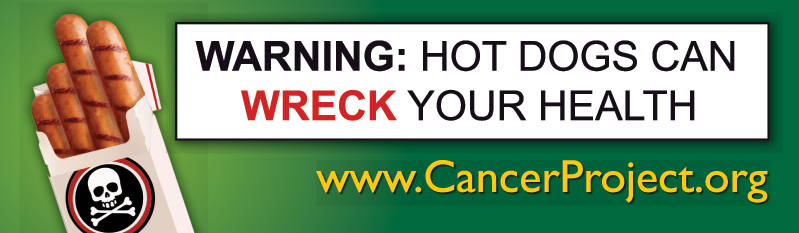
    The image above was posted as a billboard near the Indianapolis Motor Speedway, warning NASCAR Sprint Cup fans that hot dogs can kill.

    So of course, there’s all kinds of hoopla. People serve their families hot dogs all the time. It’s a lifesaver of a last-minute meal. Isn’t this sensationalist propaganda on the part of the foodie police?

    Well, yeah, maybe. But isn’t all marketing sensationalist propaganda?

    Here’s how I see it.

    • According to the American Institute for Cancer Research, just one 50-gram serving of processed meat (about the amount in one hot dog) consumed daily increases the risk of colorectal cancer, on average, by 21 percent.

    Now, most people aren’t eating a hot dog a day (I really, sincerely hope). But other processed meats are no good, either, and lots of lunches involve lunchmeat (including my personal nemesis, the dreaded Lunchables). And 21% is a lot of percents when it comes to cancer.

    Studies show a strong link between other types of cancer and processed meats.

    • An NIH-AARP Diet and Health Study found that processed red meat was associated with a 10 percent increased risk of prostate cancer with every 10 grams of increased intake.
    • A study in Taiwan showed that consumption of cured and smoked meat can increase children’s risk for leukemia.
    • A study in Australia found that women’s risk for ovarian cancer increased as a result of eating processed meats.
    • A review in the journal Diabetologia found that those who regularly eat processed meats increase their risk for diabetes by 41 percent.

    “But I buy the all-natural, nitrate-free hot dogs, like Applegate Farms.”

    Sorry, Charlie. I’ve got nothing against Applegate Farms specifically, it was just the brand that popped into my mind, but their all-natural label just means that their nitrates come from a natural source (celery powder or celery juice).

    In reality, natural hot dogs may contain anywhere from one-half to 10 times the amount of nitrite that conventional hot dogs do.

    The president of the National Hot Dog & Sausage Council counters that “trying to link a food product that has clear nutritional value with a product like cigarettes, which have no redeeming qualities, is inflammatory and alarmist.”

    Ex-squeeze me? Clear nutritional value? Are you serious? Does anyone think hot dogs are good for them?

    Here’s what makes up a hot dog: meat by-products and fat, seasoning (salt, garlic, paprika), and preservatives (usually sodium nitrite).

    So what’s a meat by-product? Trying to nail down exactly what by-products are allowed in a hot dog, as opposed to, say, dog food, is a slippery proposition. The best I can do is from the USDA website: “semisolid products made from one or more kinds of raw skeletal muscle from livestock (like beef or pork), and may contain poultry meat.”

    That vagueness is enough to make me not want a hot dog, frankly. I don’t love them anyway and I’m not gonna miss them. For the kids, we’ll treat them like any other indulgence– maybe once in a blue moon, when we’re actually at a major league ball game or at a county fair.

    Listen.

    About 143,000 Americans are diagnosed with colorectal cancer annually and about 53,000 die of it. Painfully.

    My dad was one of those.

    I don’t know. There are some risks worth taking. I don’t think this is one of them.

    The taste of a hot dog just isn’t worth it to me.

    Thoughts?

    source