Category: Food & Recipes

  • No More Flavored Milk in L.A. Schools: We’re Picking the Wrong Battles

    No More Flavored Milk in L.A. Schools: We’re Picking the Wrong Battles

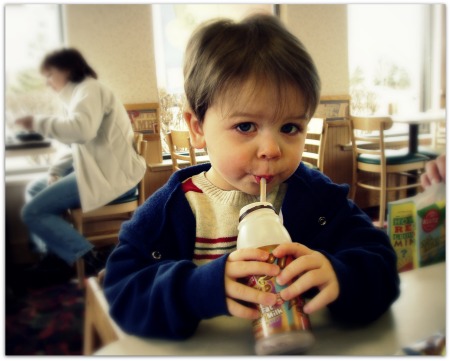
    fast food chocolate milk

    You never change things by fighting the existing reality.

    To change something,
    build a new model that makes the existing model obsolete.

    -R. Buckminster Fuller

    Look, I want to start off by saying I love Jamie Oliver and everything he’s trying to do, and every time I watch Food Revolution I wind up yelling at my TV screen in a futile attempt to shame the mean people who stubbornly stand in his way. Fight the power, Jamie. Right on right on.

    That being said: I’m seeing people celebrate the removal of chocolate and strawberry flavored milk in L.A. schools, a major campaign in this season’s Food Revolution, and the victory feels hollow at best.

    Yes, flavored milks contain more sugar, and yes, about 60% of the cartons of milk kids choose at lunchtime are flavored. But let’s be real.

    Give kids a choice between white milk, apple juice and orange juice, most kids are going to choose the juice. End of story.

    All you’ve done is swap one kind of sugar for another.

    ____________________________________________________


    But Robin,
    you may ask, why don’t kids just drink water instead?

    Why, that’s an excellent question. I’ll tell you why. Because schools are reimbursed by the federal government for the milk kids purchase; that’s true of orange juice too. But they receive no reimbursement for water, tap or bottled, because water provides no measurable nutritional value.

    I’m not blaming the schools, really. They have a very tight budget to work with and they are required to meet certain nutritional thresholds to receive their federal reimbursement, so every food is chosen based on their ability to be checked off a list of standards (which is why we get ketchup counting as a fruit/veggie).

    But seriously, come on. Kids need water.

    They need about 8 glasses a day— more for bigger kids, and during warmer months— and since they’re spending at least half their day at school, logically they should be getting at least half their water intake there.

    And yet, AND YET: how many water fountains are there in a typical school? One for every, what? 100 students? 200? More? All lined up for water? How much can they possibly take in?

    Ever drink from a water fountain? I won’t, and I’ll tell you why. They’re nasty. The water almost always tastes terrible. Metallic. It’s rarely cold. Half the time the water just barely dribbles off the faucet so you have to get your mouth right up in there. There’s no way to know what the quality of the tap water is like. And?

    Water fountains are petri dishes. You know it, I know it, I don’t really want to think about it so let’s move on.

    ______________________________________________________

    The CDC’s National Health and Nutrition Examination Survey estimates that only 15% of tweens consume enough water. Why is this worrisome?

    • Mild dehydration— defined as 1%-2% water loss; by way of comparison a supremely hardworking athlete can lose up to 30%— can negatively impact a kid’s mood, energy levels, concentration and ability to learn.
    • Mental performance (memory, attention and concentration) is reduced by about 10%, once a kid is dehydrated enough to notice they are thirsty. Performance levels worsen as the level of dehydration increases. Water is an essential element in neurological transmissions; the brain is mostly water, after all (about 80%).
    • Long-term, chronic dehydration can lead to constipation, continence problems, kidney and urinary tract infections, kidney stones, and potentially some cancers (some studies suggest drops in cancer risk were specifically associated with water, rather than other fluids). Nighttime bed-wetting could also be caused by daytime dehydration affecting bladder capacity. [source]
    • A Journal of Pediatrics study showed that giving kids more access to water— water fountains in schools and refillable water bottles— along with educating kids on the benefits of drinking water decreased the risk of being overweight by 31%.

    ___________________________________________________________

    We need to get more water, quality water into our kids, all day long. Measurable amounts, not just rushed sips from questionable fountains.

    Then we can tackle the even larger problems of the lunchtime menu: the over-processing, the sodium, the lack of fresh ingredients, the indoctrination of a fast-food mentality.

    For some kids it’s the best meal they get all day. And yet prisoners receive more balanced, nutritious fare.

    We’re celebrating taking flavored milk off the menu, but offering water is not an option. There is something fundamentally flawed about this thinking. The fundamental thinking has to change. The budget allocations have to change. The cutting corners to save a few pennies at the cost of our children’s health has to change. The factory model just isn’t working anymore, and no small swaps are going to mean enough to make a difference.

    ________________________________________________________

    Jamie Oliver is trying his best to make a difference: to get kids nutritious meals 180 days of the year. Fresh meals made from real foods that will indoctrinate actual healthy habits. A meal that is as enjoyable as it is healthy, and cultivate a healthy relationship with food. Jamie is trying to bring about a Food Revolution for our kids.

    LAUSD agreed to take flavored milk off the menu. They refused to let him revolutionize the school kitchens— hell, even to see them— and then they gave him a little parting pat on the head.

    It’s a step, sure. But I’m just not up to the task of cheering for the consolation prize.


    We must not be afraid to dream.

    Do not be caught up by the evil dogs
    that carry the names of ‘efficiency’ and ‘convenience’.

    Instead, we must be ‘unrealistic dreamers’
    who charge forward taking bold steps.”

    -Haruki Murakami

  • We Ate It: Horned Melon

    We Ate It: Horned Melon

    kiwano

    The secret of reaping the greatest fruitfulness and
    the greatest enjoyment from life

    is to live dangerously

    —Friedrich Nietzsche

    The way grocery shopping works in our house is, one kid shops with me each week. They trade off whose turn it is, and the kid who is with me gets to choose what fruits, juices, cereals, etc we buy for the week (from a set of options I give them).

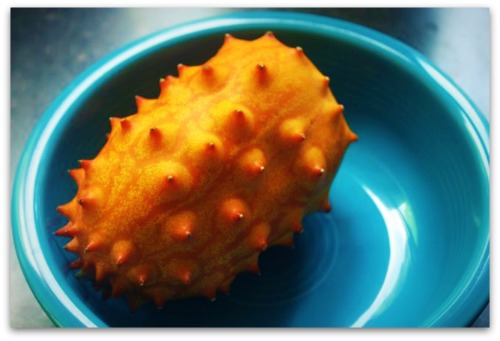
    Last week was Maverick’s turn, and he opted for the horned melon (aka kiwano).

    First off, these things are pretty seriously spiny, as in be careful picking them up. This set off alarm bells in my brain; doesn’t nature generally make poisonous things armored and/or technicolored so people won’t be tempted to eat them? I suspected the thing would be sour and awful but “life is a daring adventure, or nothing,” and certainly I love Maverick’s sense of adventure when it comes to trying new foods.

    kiwano seeds

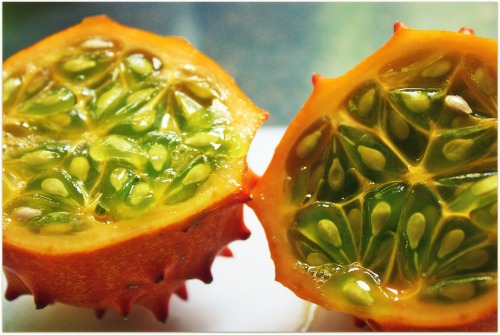
    Sliced open, the horned fruit is a whole bunch of seeds individually encased in pouches of clearish jelly. You don’t eat the seeds, just sort of suck off the sticky flesh.

    The taste is reminiscent of cucumber, a little lemony as well, and the texture of the jelly capsule is similar to the inside of a grape. It’s slimy as all get out and will turn your kitchen floor into a skating rink if you spill any.

    I have to allow for the fact that I have no idea whether this was a properly ripened kiwano, but I don’t think I’ll be adding the horned melon onto our weekly list. It was pretty gross.

    I can see this as a fun experiment for kids of a certain age who are into gross things. There are a lot of fun textures to work with here and it’s a non-toxic goop that would keep kids occupied on a summer’s afternoon. I’d say the seeds would be particularly fun loaded up into straws and shot, blowdart style, at a target— I’m pretty confident they would stick.

    In any case, I heartily recommend spontaneous buys in the produce department as an antidote for picky eating. Framing these expeditions into new foodie territory as an adventure has really encouraged my kids to try new things. Not every experiment has been successful, to be sure, but that hasn’t been a big deal.

    I had worried in the beginning that setbacks would cause my kids to be more unwillingly to taste something new; in fact the opposite has been true. Their willingness has expanded since they’re aware they’re not obligated to love each new thing.

    Tried any new foods lately? Any successes?

    _______________________________________________


  • Seven for Saturday: News You Can Use 5/14

    Seven for Saturday: News You Can Use 5/14

    scrabble board

    Soccer started early this morning; shin guards went AWOL; my link love is later than usual. My apologies.

    Whether you need interesting dinner party fodder, something to ponder while in the shower, or just something to read while waiting in line at the grocery store: I gotcha covered.

    My favorite links from the week….


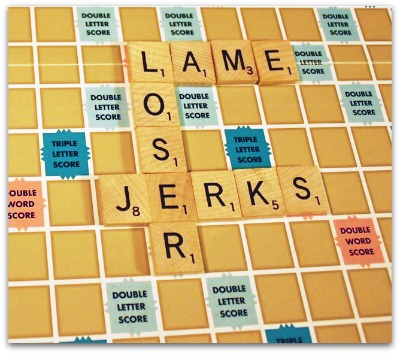
    1. Thang, innit and grrl added to Scrabble dictionary

    “Robert Groves, editor of Collins English Dictionaries and editor of the latest word list for Scrabble users, said: ”The latest edition adds nearly 3,000 new words to the existing quarter of a million available to Scrabble players. These additions are an eclectic mix of new technological jargon, overseas English, recent colloquialisms, street slang, and a few fairly well-established phrases that had not made it onto the list until now.”

    Excuse my French, but what a load of hot horse puckey. In this house we play according to the King’s English.


    2. Disney Trademarks ‘Seal Team 6,’ Name Of Unit That Killed Bin Laden

    “The applications cover ‘entertainment and education services,’ ‘toys, games and playthings’ and ‘clothing, footwear and headwear.’ “

    Henry David Thoreau said, “It is truly enough said that a corporation has no conscience,” and by that he meant, “WTF, Disney?!”


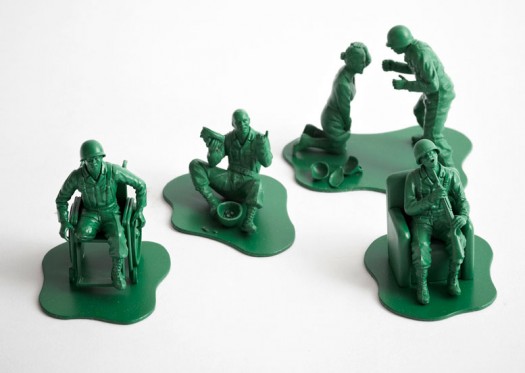
    3. Toy Soldiers Convey The Unrecorded Casualties Of War [Pics]


    I shudder to think what heroic softening glow Disney plans to put on those Seal Team 6 toys, games and playthings. My parents were the playthings of war. My uncle, permanently emotionally damaged: substance abuse problems and all the other issues that stem from there.

    Though I wouldn’t buy these for my kids either, they are a much more realistic representation of what soldiers are like… after the war is over.

    The articles focused on a single battalion based at Fort Carson in Colorado Springs, who since returning from duty in Iraq had been involved in brawls, beatings, rapes, drunk driving, drug deals, domestic violence, shootings, stabbings, kidnapping and suicides. Returning soldiers were committing murder at a rate 20 times greater than other young American males. A separate investigation into the high suicide rate among veterans published in the New York Times in October 2010 revealed that three times as many California veterans and active service members were dying soon after returning home than those being killed in Iraq and Afghanistan combined. We hear little about the personal hell soldiers live through after returning home.

    It’s no different from the stupid Disney princesses. What happens after happily ever after?


    4. Tiger Mom: Here’s how to reshape U.S. education

    Yeah, I still haven’t read the book yet. But the woman knows what she’s talking about. Tiger Cub got accepted by Yale and Harvard.

    Companion reading:

    How Do We Prepare Kids for Jobs We Can’t Imagine Yet? Teach Imagination and The Creativity Crisis: Why American Schools Need Design. I linked to both in last week’s roundup.


    5. McDonald’s sales rise 6% in April, beating expectations

    DUDE. STOP GIVING McDONALD’S YOUR MONEY. Have you not seen Super-Size Me?

    6. Cooking Real Food Isn’t as Hard as the Food Industry Wants Moms to Believe

    It’s really not. I swear. Especially now, during farmer’s market season; the less you do to fresh foods the better it tastes.

    “People not being accustomed to cooking is a bigger barrier than money or class or any of those other things that people are bringing into the discussion [of real food.]”

    Would you agree?


    7. How I Healed My Child’s Cavity

    “…cavities are caused by nutritional deficiency and when this nutritional deficiency is corrected, the cavity heals. If you think about this in an open-minded manner leaving all preconceived ideas about cavities behind, doesn’t this make sense?  Shouldn’t the body be able to heal a cavity just like it heals a broken bone or a cut on your arm?  Why would teeth be any different from a broken wrist after all?”

    Interesting; all the more so because I had the shadows of a cavity forming six months ago, and I was sure that six months of not-quite-perfect brushing with new braces on meant I’d be getting that cavity filled. At my visit last week though, I was told the soft spot had resolved itself.

    Two headines I want to share just because they’re so DUH worthy:


    VIDEO:

    Several people asked if I had seen this. To be honest, I’m more disturbed by this girl’s parents decision to post a video of her shirtless on the internet, than by her choice of lovey plaything.


    I do love this video of a sock gone missing and the quest to find him… vaguely not suitable for children for its (split-second) cartoon depiction of a body part that rhymes with sock. Via kurositas, which always has such interesting visual stuff, particularly animation. Check it out.

    For Sock’s Sake from Carlo Vogele on Vimeo.


    That’s all I got. What good stuff did you see this week?